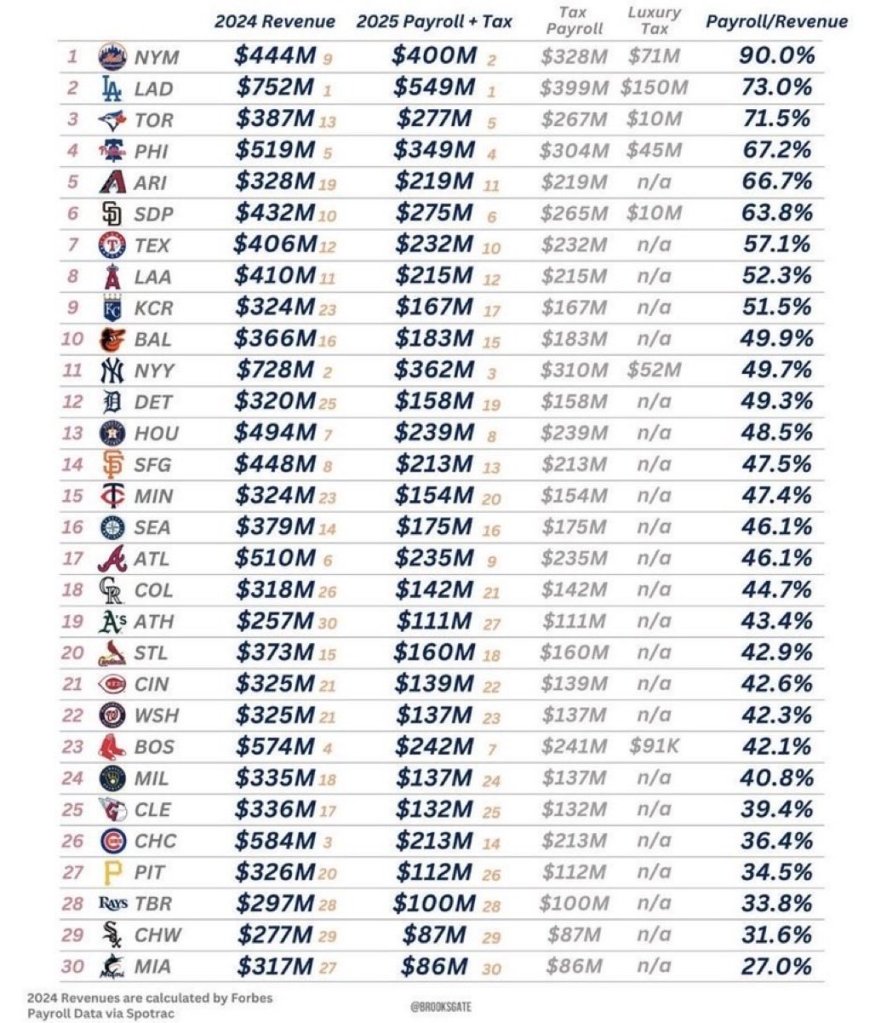
By my count, the Phillies payroll is around $302.7 million for 2026 currently, and that’s before you add on any luxury tax. They are just under a million from hitting the next tier of luxury tax, which is to say their next signing will literally cost them dollar for dollar whatever they spend. They also have a full 40 man roster currently and would have to drop someone to add anyone. Despite all of that, they almost certainly will make another move, regardless of who it is. Their roster is simply not quite as good as the Dodgers, and literally lacks a starting catcher.
The move that I and every other Phillies fan with a pulse wants is Bo Bichette. He’s right handed, he’s going to be an upgrade offensively at either of second or third base, he’s young, and yes, he’s actually good. Of course, it’s not necessarily going to be easy to get him- some of the other big spenders on the chart above also want him. He’s going to require years, and he’s going to require dollars. Probably eight to ten years for the Phillies to close the deal, and the dollars probably start around Trea Turner’s $27.273 million as a floor and move upward from there. If he’s an eight year deal at $30 million a year, at least in 2026 he’s actually costing $60 million unless the Phillies can shed enough salary to offset it.
That’s of course only one move. They need a catcher. They probably should be trying to bring back Ranger Suarez. Being conservative here, a late off-season spending spree on Bichette, Realmuto, and Suarez would probably cost $65-70 million. The Phillies could go for less expensive catching and pitching options and I wouldn’t be that mad, but you’re still talking about adding $40 million, which is actually $80 million. That’s a lot.
For this reason, there are some folks very skeptical that the Phillies can do any of this, let alone will. There’s some truth to their arguments, but I think the Phillies have already answered this, at least to a point. Back in December the Phillies offered J.T. Realmuto a contract that was reportedly somewhere near two years at $15 million a year. That money would have taken them over the next luxury tax threshold and cost them an actual $30 million this year. Assuming those numbers and reports are true, we know they were at least willing to go that far.
Let’s assume for a moment the Phillies would go a different direction than paying Realmuto and Suarez top market dollar. Let’s just start with a Bichette signing at $30 million and work from there (obviously I think the Phillies will try to buy that number down with years, but bare with me). One would assume that the Phillies will obviously try and move Nick Castellanos, but that’s likely only going to net a few million. Let’s guess $2 million for argument’s sake. They could put Taijuan Walker on the market, and I bet they would be able to get out of a portion of his contract, somewhere between $8 million and $10 million. If the Phillies moved those two and saved $10 million (for argument’s sake, again), now the Bichette signing is more like $40 million for this year, instead of $60 million post-tax, and the only issue is being a bit light on starting pitching until Zack Wheeler returns. It’s at least a start, and only about $10 million more expensive than the reported Realmuto deal would have been.
The obvious elephant in the room then is that the Phillies probably would be forced into a decision of who to keep between Alec Bohm, Bryson Stott, and Brandon Marsh. The general group thinking is Alec Bohm and his $10.2 million salary go- he makes the most, it’s a walk year, and the Phillies have kind of grown impatient with him. On the contrary though, he’s a right handed bat, you really are only trying to man third base until Aidan Miller is ready later this season or next, and he probably gets you the least back as a rental (the others have two years left). Obviously if you did move Bohm’s salary along with Castellanos and Walker, you’d basically cut the impact of the Bichette deal down to $10 million or less in taxable money, or less than you originally offered Realmuto. You could go bargain shopping then at catcher and getting a fifth starter, and probably come out right around what you originally planned to spend. That’s of course assuming you don’t fill one or two of these needs moving Bohm, Walker, and Castellanos.
There is an argument to deal at least one of Stott and Marsh though instead, and others have already made some of the arguments very well. It’s worth noting that under the assumption the Phillies get Bichette, Boston does not. Boston is actively seeking infield help up the middle and probably now at third base. Bryson Stott would probably have a ton of appeal to them, as they could move him back to shortstop and bump Trevor Story over to second, and have a really good defensive tandem up the middle. Boston could also want Bohm, or even Edmundo Sosa, and the Phillies could get out from under a lot of money if they somehow flipped any two of them. Boston is also a team that has a surplus of outfielders. The obvious name everyone will scream is Jarren Duran, but there will be a competitive market for him, and they have others too. What if the Phillies could pull off a move like that though? The market on Stott would be very healthy (Yankees? Angels?), and the Phillies could fill another big need by moving him. If they were to get a right-handed hitting starting corner outfielder, it would make Marsh available on the market then as well. Brandon Marsh is coming off of a very nice season and could very well land the Phillies back a catcher, a back end starting pitcher, or utility player as part of the package. Stott and Marsh together will make $11.1 million, or $900k more than Bohm, which would even further negate the impact of the Bichette signing on the luxury tax.
All of these are hypotheticals, and trades move slower than a lot of fans of baseball like. I’m not really sitting here saying that the answer is to trade Stott to Boston for an outfielder and turn around and trade Marsh for a starting catcher, while signing Bichette, trading Walker and Castellanos, and bringing in another arm. I’m mostly saying there are totally plausible ways though for the Phillies to afford Bichette and possibly even another player or two while staying somewhat within range of the budget they had set for themselves before. The presumption that signing Bichette is a $60 million cost this season sort of presumes they can do nothing between now and next off-season when they get hit with the bill. As I see it, the Phillies have multiple ways to re-tool their roster and stay somewhat close to budget. As for the details of those pathways, Dombrowski should be working on them now, so he can put his best offer forward to Bichette.
 Apocalypse Vibes