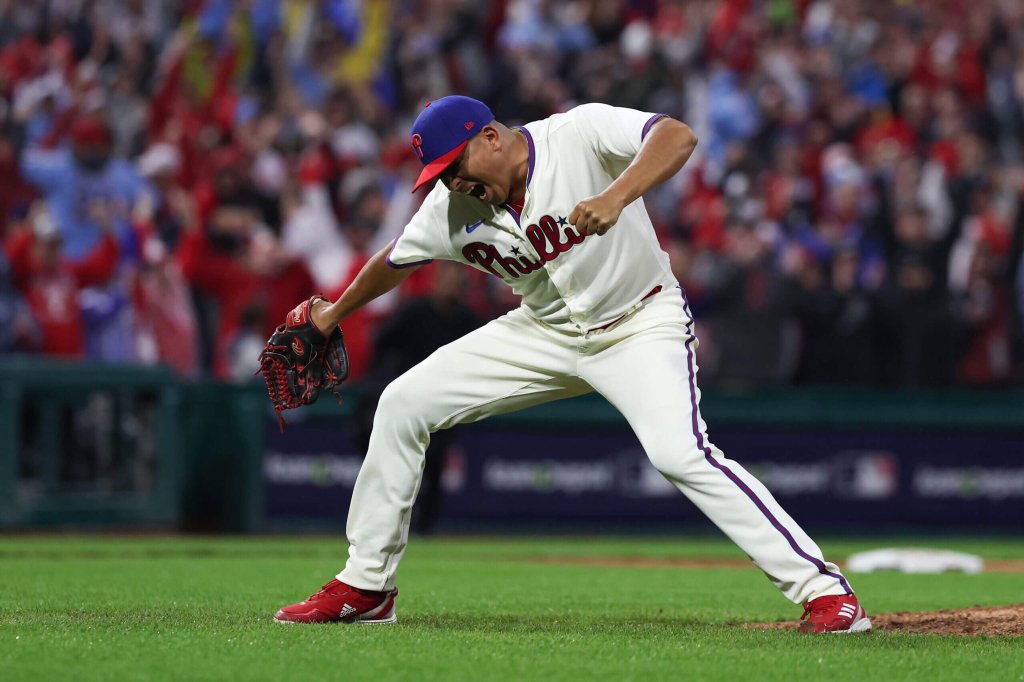
It was kind of a tough week for a lot of Phillies fans, even if some of us are less mad than others. First, Ranger Suarez left for Boston. That was sort of a known for a while (at least that he’s probably leaving), but is still easily the biggest blow to the Phillies roster this offseason. Ranger broke out as a closer in 2021, and then as the #3 starter on the 2022 NL Champions. He famously got the last out of the 2022 NLCS (See above) and threw a shut out in game three of the World Series that year. He made the All-Star game in 2024. More than anything, he was dependable. You were going to get almost exactly 25 or 26 starts a season, his ERA would be in the threes, and he’d be money in the playoffs (other than 2023’s game seven). The Phillies should be able to recover from this loss between the returning Zack Wheeler and the arriving Andrew Painter, but shoulds aren’t assured. This one definitely hurts them and removes a fan favorite.
Now that we have gone through that, let’s get to what transpired this week and really has people up in arms. The Dodgers paid a literally absurd $60 million a year to Kyle Tucker, a very good player, but not nearly on the level of Judge, Ohtani, or Soto, even at his best. Hell, it’s a literal absurdity that this guy is going to make double Bryce Harper this season (actually more), but the Dodgers can do that, and they do. They have a gigantic market, the second largest city in America and the largest county by a lot, and their TV deal is a monstrosity. It also really doesn’t hurt that back in the 2011-2012 era when the McCourt family owned the team and was in bankruptcy, MLB created a sweetheart agreement with them that shielded most of their TV revenue from the revenue sharing agreement that governs other big markets, like their neighboring Angels, the New York teams, Philly, Chicago, Boston, and the San Francisco Giants. The deal made total sense at the time and was the right thing to do (MLB was never going to let the Dodgers go under). To the credit of the Dodgers ownership, they put the extra money they make directly back into signing players, which is what fans should want. With all of that said, that agreement is no long necessary to the survival of the Dodgers. It is long past time for MLB to wrap the sweetheart agreement up, or let the other big markets play under the same sweetheart deal for the duration of the Dodgers deal. The Dodgers aren’t cheating or even doing anything they shouldn’t, but it’s not a fair or equal system for even the other big spenders.
I mostly mention the Dodgers here because their Tucker deal set off dominoes that did in fact impact the Phillies. Man-child Mets owner Steve Cohen was so shocked that the best player on the market didn’t want his money (like Alonso and Diaz, which is telling), that he not only pivoted to his next target, he made him an offer that was 150% of his existing best offer, annually, up to that point. It looked like Bo Bichette was coming to Philadelphia as late as Friday morning, and had a seven year, $200 million ($28 million a year) offer in hand, but Cohen turned around and gave a player that really doesn’t even fit on his roster three years and $126 million ($42 million a year). While it’s true they had talked to Bichette before that, the offer came in after being rejected by Tucker, and appears to have been negotiating against himself- no one else even considered offering Bichette $42 million a year. Now, I’m not going to tell you Bichette isn’t good, or that I didn’t want him in Philly, that’s childish, however I’m going to tell you that I would have rioted if the Phillies paid him anything near that. Bichette was smart to accept the wild overpay from the Mets, even if it means he probably won’t win a championship for a bit. If he plays out the whole contract, he would be 30 years old and only need a $74 million deal to match the total of what the Phillies offered him. He’s now going to crush $200 million in free agency earnings and be set up for life. Good for him, I don’t blame him at all.
None of this was good for baseball. The Dodgers showed us in 2025 that they could literally limit each of their pitchers innings and sleep walk to 90 plus wins and a spot in the postseason, and signing Tucker and Diaz this offseason only reinforces that. By doing what they did, the Dodgers and Mets are only increasing the likelihood of a lockout after the 2026 season, giving the small market owners more leverage to call for salary caps or increased revenue sharing, things I absolutely hate because they reward shitty owners (looking at you Pirates and Athletics). Salary caps don’t work. The NHL’s salary cap wrecked the sport. Even basic trades are nearly impossible in the NBA because of the salary cap. People celebrate the NFL salary cap for “creating parity,” but tell that to continuously shitty franchises in Cleveland, Cincinnati, Dallas, and Las Vegas that turnout huge profits each year. The NFL salary cap has just watered down what a great team is. Now we’re probably going to have a lockout because owners won’t even be able to agree to what they want, and even if they do, the players will never go for that. Sure, Dodgers fans can say “cry harder” about it, but what’s the point of having a dynasty if the sport ends up skipping a year or two because of it?
If I ran MLB, I would make a few simple fixes that would even out a lot of these problems without a hard cap or lockout.
- Make deferments of pay count 100% against the luxury tax now. This one is pretty simple and would eliminate deals like Shohei Ohtani’s giving teams that are rich and good a windfall of cash to spend on other players.
- Set a salary floor. Yes, I really don’t want to see the Athletics owner put a slop product out on the field and pocket tons of cash because fans like me will travel to Vegas to watch our team on the road. All of these teams bring in enough revenue to pay competitive players. Right now there are a half dozen to dozen cities in the league that aren’t even making a bad faith attempt to win games. That is bad for the league on every level. Every owner is rich. If the burden of trying is too much for you, sell.
- Subject all media revenue to revenue sharing for every team. Yes, I’m looking at you, Los Angeles. No more sweetheart deals, ever. Again, since we’re going to make small market owners spend to at least a bare minimum now, I think you sweeten the revenue sharing agreement for them as well.
- Incentivize teams to re-sign their own star players. I think every dollar spent on someone else’s free agents should count against the luxury tax number. Every dollar on your own guys? Perhaps if Pittsburgh were extending Paul Skenes, that could count at a reduced rate against the tax. 90%? 85%? You can figure out the number. Make it more appealing for small market teams to keep good teams together though when they build them. Hell, this is even good for big market teams. If Kyle Schwarber only was a 90% hit against the tax, the Phillies would have had more money to spend this offseason. I’d even go so far as to incentivize a team more to continuously re-sign homegrown players they keep throughout their careers.
- Institute an international draft. I think we’re almost universally tired of seeing players from Asia pick the same two or three teams. The situation in Latin America has improved dramatically with caps on what teams can spend there, but it’s still all relative to how your franchise wishes to use it. I’ve never really seen a good reason why international players aren’t subject to a draft system, even if it were like the Rule 5 draft or waiver wire, that would allow every market a chance to tap into some of the global talent. Basically international players can still choose to sign with teams who are already good, and make the rich richer. Spread that talent out.
- Tier penalties for signing players who receive a qualifying offer. There are teams who simply can’t afford to sign a player who received a qualifying offer, because they can’t afford to lose draft picks on the first two days. What if teams in the bottom third of the standings the season before could sign players without losing their picks? This would be quite an incentive to go out and try to compete, especially since we’d now have a salary floor.
- Stiffen luxury tax penalties for repeat offenders in higher tiers. Take first round picks in both the domestic and international drafts and make new signings count 110% on the luxury tax for other teams’ free agents. Give them no compensation for losing a player with a qualifying offer. You can make it hurt enough that they’ll think about it. 29 teams have a budget as is, the tax on it’s own has an impact.
These are just a few ideas to try and bring competitive balance to the league. Look, we all know some NBA teams just make paper transactions to meet the salary minimum, and some of these owners will try to do that. We also know there are teams like Washington with huge markets and rich owners who aren’t even faking that they want to win right now, who would just do the bare minimum until they think they can win. At least under this system you would be preventing them from pocketing as much cash.
Now, so back to my Phillies. They did re-sign J.T. Realmuto this week for three years and $45 million. Technically when that becomes official they will have 41 players on the 40 man roster (and Justin Crawford will still need a spot), so someone will have to come off soon. This puts the current projected payroll at $316,780,437 for 2026. My guess is they will try to shop Garrett Stubbs or Rafael Marchan, as both catchers are out of options and one will have to clear waivers when they don’t make the team. Nick Castellanos is obviously a candidate to go now too, and with a lack of right handed hitting outfield and DH options left, he should have some market if the Phillies are willing to eat at least $15 million to move him. With that said, if we are not considering the clubhouse issues, Castellanos wouldn’t be the worst right-handed platoon partner with Brandon Marsh in left (Trust me, they aren’t considering it). Taijuan Walker and his $18,000,000 salary is a candidate to go, and the Phillies could probably move at least $8-10,000,000 of his money off the books now if they wanted. Given the loss of Ranger though, the rotation is a bit light and probably could use him around for depth. Of course, Alec Bohm, Bryson Stott, and Brandon Marsh are all potential trade pieces yet, particularly if the Phillies make any more free agency moves. The Phillies could use another depth pitcher, a right handed bat to hit behind Harper, and if we’re going with Marsh in left, perhaps an upgrade right-handed platoon partner.
The market is not dead yet either. Eugenio Suarez seems like the most straight forward offensive upgrade available. He’s right handed, he plays third base, and he hit 49 homers a year ago. He does strike out a lot, his defense isn’t good, and he’s old. If he can be had on a two year deal, I would be less than shocked if the Phillies paid him $25 million a year. Look, they were offering Bichette $28 million and Realmuto $12 million a year as of Friday morning, so Suarez for $25 million and Realmuto for $15 million fits exactly into the financial footprint. It also makes trading Bohm and his $10.2 million one year salary a pretty straight forward salary dump without a particular need in what you get back. Suarez is flawed in plenty of ways, and you can question if you want to sign him and put Aidan Miller at second if and when he arrives, but he’s a pretty straight forward move. He’d also be the best cleanup option the Phillies have had since Ryan Howard’s prime.
Of course there is also Cody Bellinger. The fit here is a little less obvious, as while Bellinger was probably only second to really Tucker on this market, he’s left handed and the Phillies have plenty of that. Of course, if they signed Bellinger, he’d probably replace left-handed hitting Brandon Marsh, so he doesn’t really make things worse. Bellinger can play any outfield spot, hits for power, and would probably mash in the Phillies ballpark. The Phillies could probably offer him the exact same seven year, $200 million deal they offered Bichette and get him too, as he is reportedly sticking to seven years in his talks with the Yankees. Do I love that deal with him? Look, I think he has a really good four years in front of him, I’d be fine with him at five, but those last two years will probably be ugly. Even so, the Phillies window is realistically three years with this group, so what if you eat a few bad years after that. Sure, he and Harper are both lefties, but both can hit lefties, so I don’t mind them hitting back to back. Now, it’s true that if you pay him $28-30 million, he and Realmuto are more expensive than they seemed to be willing to go before, but it would also open up Marsh for a trade that would even things back out. I get why some people don’t love this idea, but Bellinger is a great player and could be a decent fit for the Phillies if they want.
I also wouldn’t count out that they decide to just bring back Harrison Bader and role the dice with four starting outfielders on the opening day roster, playing whoever the hot hand is at any given time. In fact, I don’t really hate this at all. A two year or even three year deal around $12 million a year with Bader would free up some cash for the Phillies to even go out and look for another starting pitcher, perhaps an older guy that could give you 20 good starts or a swing man, and make trading Walker plausible again. I definitely wouldn’t be mad at that.
Somehow, despite all that happened, a lot more probably will happen in baseball over the next month. That’s what makes it fun though- scrolling twitter and reading all the rage tweets from people when the Dodgers land Peralta, or Phillies fans lamenting the team being “cheap” for not giving an infielder who has never hit 30 homers and has no position more money than Aaron Judge to play here this year. What would life be without this?
 Apocalypse Vibes