I’ll go on record again- I think Josh Shapiro would have been a horrible pick to be Kamala Harris running mate. If they had selected him, they would have been swallowed whole with questions about Gaza and foreign policy. As with any VP pick, I find it questionable that he would have actually converted over any voters who didn’t vote for Harris, in Pennsylvania or elsewhere. This isn’t really a knock on Shapiro, I think we can say Tim Walz really didn’t add anything positive in the end either, and he was the selection. I find it questionable that J.D. Vance, Kamala Harris, Mike Pence, Joe Biden, or Dick Cheney really moved the needle for their bosses, and they were all winning VP’s. Honestly, the selection is basically an albatross around the nominee’s neck under almost any circumstances, and most of them don’t even carry their home state for the nominee unless they were going to win it anyway. Shapiro would have been the same, which probably makes him no better or worse than anyone else she could have picked. I think Harris was going to eat a shit sandwich no matter what.
I think it’s obvious that the pot-shots both Harris and Shapiro have taken over the selection process for VP is entirely about 2028 primary politics. Now I also think they may genuinely dislike each other, which isn’t shocking to me, but we shouldn’t put a lot of real stock in what either says. She wants people to view him as a self-absorbed, overly ambitious white man and he wants to paint her as anti-Jewish and anti-Israeli. Well, both probably succeeded with some people, though I find both kind of silly. If anything, both are making Gavin Newsom and J.B. Pritzker look like good options.
I’ve said this for a long time, and I think Donald Trump has proven it- it’s easier to get nominated for President than for Vice-President. Voters can decide what they care about from your baggage, but when you are considered for Vice-President, one person gets to judge your baggage. That person’s team gets to comb through your life and probe anything they want- and often all they are trying to do is see how you’ll react to being exposed, attacked, and prodded. They asked Shapiro about his connections to Israel, they asked Walz about his connections to China, God only knows what they asked Mark Kelly about. In 2020, Karen Bass was called a communist sympathizer in the press during the selection process, for a job she didn’t end up getting, and didn’t even end up with a cabinet job as a consolation. Is that worth it? I would say no.
If Vice-Presidents were picked in some other way, it would actually be a pretty good job. Your entire job entails breaking ties in the Senate and going out in public and selling the administration’s initiatives. You live in a great house at the Naval Observatory, you have a motorcade everywhere, and you have the top clearance in the government. It’s a great job. Getting there sucks. Frankly, it’s not worth the trouble. If I were interested in running for office, I wouldn’t bother with the Vice-Presidency. Is it worth all of this noise? No, just run for President at that point. If you’re going to take the beating, you might as well take it with a much more forgiving audience where you can make your own case. But I’m not psychotic enough to run for either right now.
My new newsletter on Substack will be a less frequent, more big picture items type of outlet. You can subscribe at “The Dark Side of the Dawn.” This is the first piece.
Do you remember 2020? It’s ok if you don’t, it really was a long time ago, and it was not a pleasant time for anyone. But if you can get just a little further back, to 2019, you might remember the Democratic Primary race for President of the United States. There was literally more than 20 candidates running, and they held debates where literally all of these people participated in one form or another. Moderators asked them to raise their hands if they agreed with statements like “defund the police,” or if they pledged to implement “the Green New Deal,” or if they would enact reparations for descendants of former slaves, and all kinds of different stuff. For the most part, everyone on stage raised their hands. Candidates who had spent years carefully building their public persona were suddenly racing each other to show they were further left, more “woke” I guess is how some people would put it. The one who basically refused to raise his hand for most of this stuff was Joe Biden, the former Vice-President of the United States and guy who progressives like Larry Krasner called dumb, while others said he was out of touch, and others yet questioned his mental fitness. Hell, he was called racist for working with Dixiecrats in the 1970’s, with the obvious moment everyone remembers being his confrontation with Kamala Harris during an early debate. One by one though, all of those candidates dropped out, rejected by a primary electorate of Democrats who gave Joe Biden the cleanest and clearest primary victory for President since 2004. Progressive heroes like Bernie Sanders and Elizabeth Warren, supposed young up and comers like Julian Castro and Cory Booker, and moderate stalwarts like Amy Klobuchar and Pete Buttigieg all had varying levels of success, but Biden had either knocked them out of the race or sealed off their pathway to the nomination by the end of Super Tuesday. The Democratic Primary voters picked the older than hell moderate guy. Then the older than hell moderate guy picked the “cop” prosecutor lady from California as his running mate and guess what? They’re the only Democratic ticket out of three that managed to beat Donald Trump in a Presidential race.
There’s an uncomfortable truth for progressives and “establishment” Democrats alike about this period after Barack Obama’s Presidency, a period dominated by in all aspects of American life by Donald Trump. Donald Trump did better with many core Democratic leaning demographic groups than Mitt Romney or John McCain literally from the beginning in 2016. Trump has improved his standing in each subsequent election (albeit, not always by a lot) as a percentage of the vote with African-Americans, Latinos, and Asians. Trump has received more votes in each of his successive elections than the previous election, and he has received a higher percentage of the vote in each election than he did in the last. You don’t have to like it, but the truth is that MAGA has appeal to a lot more people than Democrats want to believe, and many of the truths Democrats held as gospel about demographics and the future of the country after 2008 and 2012 were simply not true, or at least are not true anymore. The country did not reject the personal failings, the crass language, the confrontational, bullyish style of Trump. They didn’t care that he trampled norms, or that he’s nasty, or that he even broke the law. There was something appealing about what he put forward, and that appeal actually cuts across demographic lines. In fact, Democrats in 2024 did not really have a particular “white voters” problem- Kamala Harris even won college educated white men, a first for a Democrat since the days of Kennedy, Johnson, and Carter.
He did lose once though, and that once was to Biden/Harris. To hear the DC group think though, by 2024 Trump would have defeated them in a rematch, and he did end up defeating Harris. There is an arm of the Democratic Party that Biden defeated in 2020 who wants to fill in the blanks about why. They want to blame Gaza, they wanted to blame student loan forgiveness being struck down at one point, and they basically want to point the future of the party in the direction of the populist left. They point at rather small data points like Dearborn, MI (where Gaza probably did make the difference) to back up their point. They point to victories by progressives in deep blue municipal elections, without point out that their candidates didn’t really do that great, relative to what a Democrat should do. They point to unrest amongst younger voters with Biden and Harris, without pointing out what a tiny share of the electorate that really was, compared to the whole. They’ve created a case for a party that embraces big government liberalism, abandons traditional central points of American foreign policy dating back to the end of the Second World War, and more closely resembles something like Corbyn’s British Labour Party or a European Social Democratic Party in policy and rhetoric. Some of them make the case quite compellingly. The problem is their case is fiction.
Saying that Harris lost because of Biden being old, or that she was too moderate, or any of the go-to’s of terminally online leftists and radicalized coffee shop folks is comforting. It’s false. The truth is that while voters knew about Trump’s first term, his part in January 6th, his alleged crimes, his role in overturning Roe v. Wade, and really everything about Trump, they viewed Harris as more extreme (while this links to a Fox article, the polling was from the New York Times). Post-election surveys showed an electorate that thought Harris and the Democrats had their priorities wrong and took far left positions, even in cases where she didn’t. In fact, Harris was literally caught up in a bad brand. She was too generic Democrat, in part because of her own failed 2020 campaign, and she simply couldn’t overcome that.
To the extent Joe Biden did hurt her, I think it’s been overblown that it was because he stayed in the race too long. The truth is that most voters picked Biden in 2020 because he wasn’t like the generic Democrats that they imagined, something that was born out in Biden winning and House Democrats actually losing seats from their 2018 majority. I think this portion of “The Liberal Patriot’s” critique of Biden and Harris actually hits pretty close to home with my experience on the campaign:
Finally, Harris’s refusal to distance herself from President Biden likely complicated her efforts to fashion herself as a moderate. Though Biden ran to the center of the 2020 Democratic primary field, he made a conscious decision at the beginning of his presidency to swing left. He demonstrated this early on by hiring staffers who had worked for Senators Elizabeth Warren and Bernie Sanders in an effort to ingratiate himself with the party’s progressive faction. Meanwhile, he shunned moderates like Rahm Emanuel and Larry Summers, veterans of the Obama White House.
This was also evident in how he governed. Biden made a concerted effort to push policy ideas that thrilled the progressive wing of the party, such as the COVID stimulus package early in his administration, which has since been linked to the subsequently higher rate of inflation. He also acquiesced to their demands on a liberalized asylum policy and student debt forgiveness, neither of which went over well with the public. Biden additionally took controversial actions related to race and social justice. One of his first acts as president was signing several executive orders related to advancing “equity,” one of which called for “an ambitious whole-of-government equity agenda.”
Perhaps all this is why in the early part of summer, just before Biden dropped out, polls showed that more voters saw him as “ideologically extreme” than said the same about Trump—and why Harris’s insistence on embracing him during the campaign may have hurt her. Indeed, Blueprint’s polling found that among the other reasons voters chose not to support her was that they viewed her as too closely tied to Biden.
I’m a huge Joe Biden fan and proud alum of his 2020 campaign- hell I was a delegate for him in 2020. He campaigned as the most moderate Democratic candidate in the primary field, but that guy never governed. Right around the time he had basically secured the nomination and Covid hit and shut down our headquarters, the campaign underwent a leadership shift that brought with it an influx of staff from Beto, Warren, Sanders, and others. Many Hillary alums who hadn’t been on the team were brought in as well. During the long “work from home”/”virtual campaign” period, many of these folks took fairly important roles. That continued right on into the administration. Biden, like Hillary before him, sought to bring progressive Democrats into his fold for the general election by promising to be the new LBJ and promising bold action. Was it unifying to Democrats and sounded good in 2020? Sure, I guess. Over time though, the Biden that governed seemed a lot more similar to an AOC than a Blue Dog Democrat, and people weren’t really excited about that outside of the party faithful. That was even more true as inflation hit in 2021 and 2022, and the administration had made a conscious effort to prioritize employment an wage numbers over holding down inflation. Basically, they started to tune him out then.
Look, I’m of the opinion that it was the kiss of death to try and appease Bernie Sanders in 2016, but that’s long over with. The truth is that 2026 will be about the Trump Administration, and Democrats should be able to win that election if they can talk coherently and plainly about health care premiums, continuing rising inflation, housing, and kitchen tables issues. Literally don’t mix this stuff up with activist speak, talk prices and affordability, and we’re good. In the longer run, like say 2028 though, I’m not as sure right now. Sure, the public hates ICE and the Trump Administration’s actions on immigration. Will they vote against it if we go back to Biden’s more liberal policies on asylum and immigration though? I doubt it. If we’re able to get out of our own way and admit that Barack Obama’s orderly, humane, and due process driven deportation policies that deported a shit ton of people here illegally actually did work pretty well, we might be able to win the issue. I’m not sure though. We have mini-Mamdani candidates and people trying to run as clones of John Fetterman in 2022 popping up all over the place. This isn’t sustainable. Even if it doesn’t kill us in 2026, and realistically it shouldn’t, it’s poison for 2028.
It’s fairly easy after your rejected to recoil and take the position that you weren’t true to your values. That doesn’t mean it’s true. Democrats get a minimum of 48% in literally every Presidential election, dating back as far as 1996, and while there’s meaningful divides in that electorate, the reality is that a large majority of those votes are not terminally online activists. That’s even more true for the voters who are not consistent Democratic voters. Those extra voters that pushed Biden and Obama up over 50% are not closet liberals waiting for a Bolshevik Revolution, they really don’t want to hear about the virtues of Hamas, giving taxpayer funded gender re-assignment surgeries to prisoners, confiscating guns, taxing churches, making all cars electric, or open borders. I’m not saying liberals are right or wrong on those subjects (I have some nuanced views of what is actually right there), I’m saying the voters who voted Obama/Trump/Biden/Trump (or didn’t show up in Trump’s wins) don’t love the Democratic Party, and would prefer we not cater to our activists. We can ignore them, that’s certainly an option, but that option probably doesn’t go well.
I got a text this morning with some news about the PA-7 Congressional primary- Republican Ryan Crosswell is losing his campaign manager to Governor Shapiro. You may remember the manager from this, so maybe you don’t think it’s a big deal, but we are now only a couple months from the primary. I don’t know this person, so there is no way to confirm it, but it would obviously change the campaign a lot if it’s true.
It may or may not be a big deal for Crosswell. He was burning some 40% of his campaign money up to this point, and probably needs to spend it since no one knows who he is. With that said, it’s more telling to me where this text says the manager is going- the Governor’s campaign. You wonder who initiated this, and if it’s just the latest attempt to try and rig this primary for Crooksy, because they fear he can’t do it himself unless he is running against a bunch of incompetent candidates? The amount of effort to create a candidate with this many flaws is remarkable to me. Why not just back one of the actual Democrats from the Lehigh Valley who wanted to run to begin with?
… And then there were four. Are you ready for the best Sunday of football this year? It’s time for the conference title games. As the season winds towards it’s conclusion, I think we can come to one major conclusion- this was a season of change. Kansas City, Philadelphia, and San Francisco are all not here (don’t write their permanent obituaries, but still). In fact, the only team playing in these conference title games that went past the first round in last year’s playoffs are the Los Angeles Rams. A new generation of great teams has arrived, and they will probably be around for a while.
Thoughts on both games:
New England (-4.5) @ Denver- Obviously Stidham starting instead of Nix colors any and all thoughts about this game for everyone. The former Auburn Tigers QB has played but a hand full of snaps all season, but does have experience as a starter in the NFL. Even so, I find it hard to believe that Vrabel’s defense isn’t going to frustrate him and take advantage of his mistakes after the way they handled Herbert and Stroud the last two weeks. New England very well might have won this game with Bo Nix playing. I’m taking them to cover as is.
Los Angeles @ Seattle (-2.5)- I’m kind of surprised by the early narrative about this game. I figured everyone would be predicting LA to walk back to the Super Bowl, but instead it’s Seattle who is the early favorite. Well, they looked like a team who should be favored in destroying San Francisco, backing up their top seed. LA didn’t look incredible in beating Chicago, but let’s consider something- they beat the #2 seed on the road in tough weather and a tough environment. That’s more impressive than we give it credit. Home field is a huge advantage usually, but this is a division game and I don’t think it matters as much. With that said, Seattle has looked like the best team for several weeks now. My head tells me they can’t beat LA twice in a row, but I watched what I watched this weekend.
As for who to cheer for- I don’t care very much. A Broncos win would be funny, but I don’t like Sean Payton. Can anyone in America wish more good for New England at this point? I do like Vrabel and Maye though. Seattle and Sam Darnold winning would silence a lot of narratives, but it could also jump start a run for them, and I don’t like that. Does anyone really want to see Los Angeles win anything right now? Let alone McVey fanboys will come out of the woodwork again. But I like Stafford a lot, and him winning a second title would cement his legacy. I’m totally ambivalent here. They’re all fine. They’re all not.
On to the updated rankings. From #9 back stays the same for now. From #5 to 8, this is the final placement. Here you go.
When is a receiver down by contact and when do they have to “survive the ground.” I’m not saying the refs screwed the Bills or the Bears with the way it was called this weekend, it seems to me like the rule is unclear, but isn’t that kind of a problem? Those plays could have changed seasons. How are we in 2026 and can’t have a uniform standard for when a receiver is down?
Should the Texans call Cincinnati? Ok, I’m serious here, C.J. Stroud for Joe Burrow is probably a ridiculous reach, but after that playoff performance by Stroud, you can’t help but wonder if the Texans would be championship favorites next year if they could pull it off. Look, a lot of teams will call about Burrow, but unless he demands a trade it won’t happen.
The Bills job is really attractive, but who is a real upgrade on McDermott? It’s fine to fire your coach because of continually coming up short, but don’t you need to have someone better to hire? I’m not sure who that coach is right now.
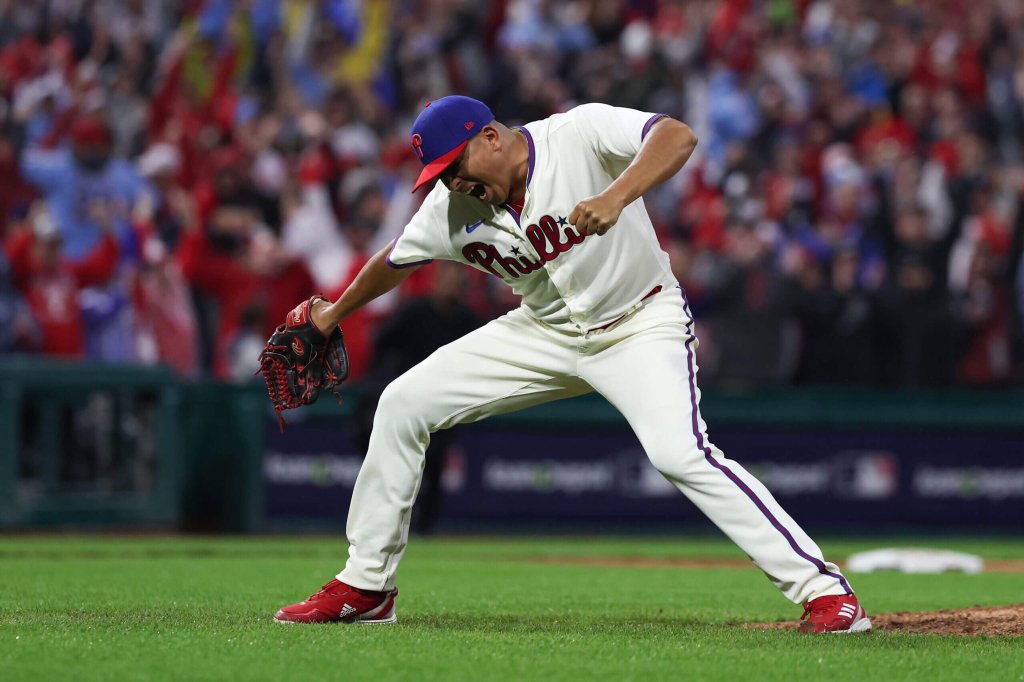
It was kind of a tough week for a lot of Phillies fans, even if some of us are less mad than others. First, Ranger Suarez left for Boston. That was sort of a known for a while (at least that he’s probably leaving), but is still easily the biggest blow to the Phillies roster this offseason. Ranger broke out as a closer in 2021, and then as the #3 starter on the 2022 NL Champions. He famously got the last out of the 2022 NLCS (See above) and threw a shut out in game three of the World Series that year. He made the All-Star game in 2024. More than anything, he was dependable. You were going to get almost exactly 25 or 26 starts a season, his ERA would be in the threes, and he’d be money in the playoffs (other than 2023’s game seven). The Phillies should be able to recover from this loss between the returning Zack Wheeler and the arriving Andrew Painter, but shoulds aren’t assured. This one definitely hurts them and removes a fan favorite.
Now that we have gone through that, let’s get to what transpired this week and really has people up in arms. The Dodgers paid a literally absurd $60 million a year to Kyle Tucker, a very good player, but not nearly on the level of Judge, Ohtani, or Soto, even at his best. Hell, it’s a literal absurdity that this guy is going to make double Bryce Harper this season (actually more), but the Dodgers can do that, and they do. They have a gigantic market, the second largest city in America and the largest county by a lot, and their TV deal is a monstrosity. It also really doesn’t hurt that back in the 2011-2012 era when the McCourt family owned the team and was in bankruptcy, MLB created a sweetheart agreement with them that shielded most of their TV revenue from the revenue sharing agreement that governs other big markets, like their neighboring Angels, the New York teams, Philly, Chicago, Boston, and the San Francisco Giants. The deal made total sense at the time and was the right thing to do (MLB was never going to let the Dodgers go under). To the credit of the Dodgers ownership, they put the extra money they make directly back into signing players, which is what fans should want. With all of that said, that agreement is no long necessary to the survival of the Dodgers. It is long past time for MLB to wrap the sweetheart agreement up, or let the other big markets play under the same sweetheart deal for the duration of the Dodgers deal. The Dodgers aren’t cheating or even doing anything they shouldn’t, but it’s not a fair or equal system for even the other big spenders.
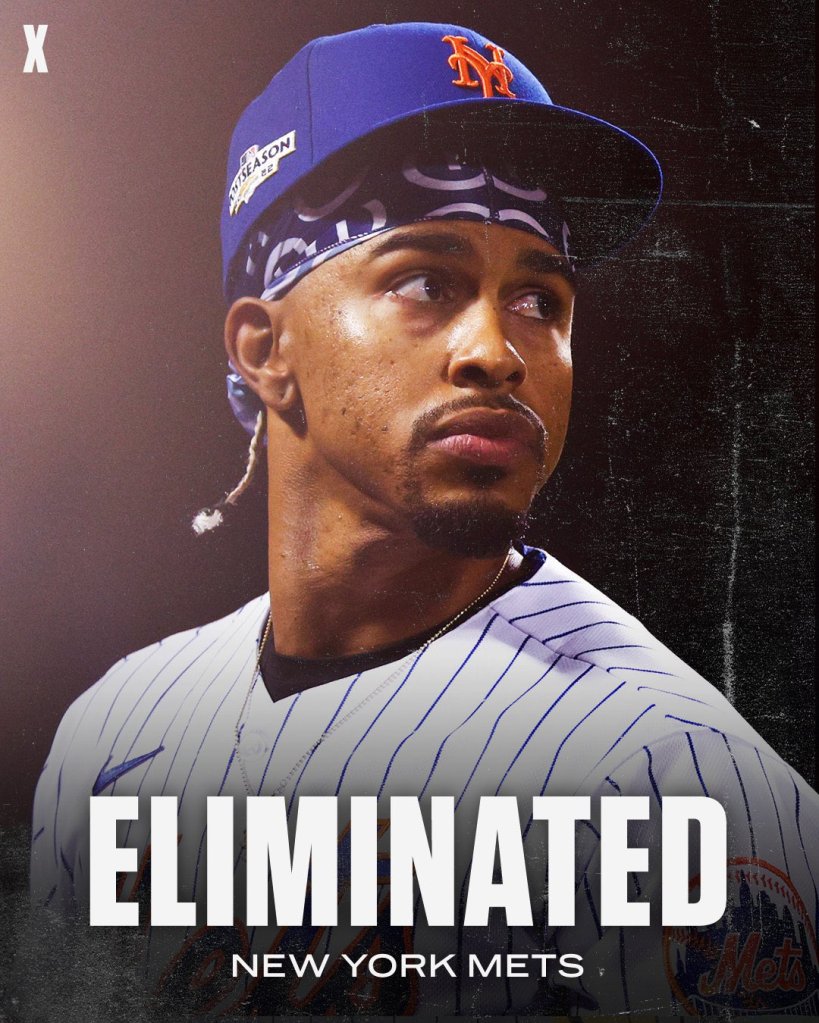
I mostly mention the Dodgers here because their Tucker deal set off dominoes that did in fact impact the Phillies. Man-child Mets owner Steve Cohen was so shocked that the best player on the market didn’t want his money (like Alonso and Diaz, which is telling), that he not only pivoted to his next target, he made him an offer that was 150% of his existing best offer, annually, up to that point. It looked like Bo Bichette was coming to Philadelphia as late as Friday morning, and had a seven year, $200 million ($28 million a year) offer in hand, but Cohen turned around and gave a player that really doesn’t even fit on his roster three years and $126 million ($42 million a year). While it’s true they had talked to Bichette before that, the offer came in after being rejected by Tucker, and appears to have been negotiating against himself- no one else even considered offering Bichette $42 million a year. Now, I’m not going to tell you Bichette isn’t good, or that I didn’t want him in Philly, that’s childish, however I’m going to tell you that I would have rioted if the Phillies paid him anything near that. Bichette was smart to accept the wild overpay from the Mets, even if it means he probably won’t win a championship for a bit. If he plays out the whole contract, he would be 30 years old and only need a $74 million deal to match the total of what the Phillies offered him. He’s now going to crush $200 million in free agency earnings and be set up for life. Good for him, I don’t blame him at all.
None of this was good for baseball. The Dodgers showed us in 2025 that they could literally limit each of their pitchers innings and sleep walk to 90 plus wins and a spot in the postseason, and signing Tucker and Diaz this offseason only reinforces that. By doing what they did, the Dodgers and Mets are only increasing the likelihood of a lockout after the 2026 season, giving the small market owners more leverage to call for salary caps or increased revenue sharing, things I absolutely hate because they reward shitty owners (looking at you Pirates and Athletics). Salary caps don’t work. The NHL’s salary cap wrecked the sport. Even basic trades are nearly impossible in the NBA because of the salary cap. People celebrate the NFL salary cap for “creating parity,” but tell that to continuously shitty franchises in Cleveland, Cincinnati, Dallas, and Las Vegas that turnout huge profits each year. The NFL salary cap has just watered down what a great team is. Now we’re probably going to have a lockout because owners won’t even be able to agree to what they want, and even if they do, the players will never go for that. Sure, Dodgers fans can say “cry harder” about it, but what’s the point of having a dynasty if the sport ends up skipping a year or two because of it?
If I ran MLB, I would make a few simple fixes that would even out a lot of these problems without a hard cap or lockout.
Make deferments of pay count 100% against the luxury tax now. This one is pretty simple and would eliminate deals like Shohei Ohtani’s giving teams that are rich and good a windfall of cash to spend on other players.
Set a salary floor. Yes, I really don’t want to see the Athletics owner put a slop product out on the field and pocket tons of cash because fans like me will travel to Vegas to watch our team on the road. All of these teams bring in enough revenue to pay competitive players. Right now there are a half dozen to dozen cities in the league that aren’t even making a bad faith attempt to win games. That is bad for the league on every level. Every owner is rich. If the burden of trying is too much for you, sell.
Subject all media revenue to revenue sharing for every team. Yes, I’m looking at you, Los Angeles. No more sweetheart deals, ever. Again, since we’re going to make small market owners spend to at least a bare minimum now, I think you sweeten the revenue sharing agreement for them as well.
Incentivize teams to re-sign their own star players. I think every dollar spent on someone else’s free agents should count against the luxury tax number. Every dollar on your own guys? Perhaps if Pittsburgh were extending Paul Skenes, that could count at a reduced rate against the tax. 90%? 85%? You can figure out the number. Make it more appealing for small market teams to keep good teams together though when they build them. Hell, this is even good for big market teams. If Kyle Schwarber only was a 90% hit against the tax, the Phillies would have had more money to spend this offseason. I’d even go so far as to incentivize a team more to continuously re-sign homegrown players they keep throughout their careers.
Institute an international draft. I think we’re almost universally tired of seeing players from Asia pick the same two or three teams. The situation in Latin America has improved dramatically with caps on what teams can spend there, but it’s still all relative to how your franchise wishes to use it. I’ve never really seen a good reason why international players aren’t subject to a draft system, even if it were like the Rule 5 draft or waiver wire, that would allow every market a chance to tap into some of the global talent. Basically international players can still choose to sign with teams who are already good, and make the rich richer. Spread that talent out.
Tier penalties for signing players who receive a qualifying offer. There are teams who simply can’t afford to sign a player who received a qualifying offer, because they can’t afford to lose draft picks on the first two days. What if teams in the bottom third of the standings the season before could sign players without losing their picks? This would be quite an incentive to go out and try to compete, especially since we’d now have a salary floor.
Stiffen luxury tax penalties for repeat offenders in higher tiers. Take first round picks in both the domestic and international drafts and make new signings count 110% on the luxury tax for other teams’ free agents. Give them no compensation for losing a player with a qualifying offer. You can make it hurt enough that they’ll think about it. 29 teams have a budget as is, the tax on it’s own has an impact.
These are just a few ideas to try and bring competitive balance to the league. Look, we all know some NBA teams just make paper transactions to meet the salary minimum, and some of these owners will try to do that. We also know there are teams like Washington with huge markets and rich owners who aren’t even faking that they want to win right now, who would just do the bare minimum until they think they can win. At least under this system you would be preventing them from pocketing as much cash.
Now, so back to my Phillies. They did re-sign J.T. Realmuto this week for three years and $45 million. Technically when that becomes official they will have 41 players on the 40 man roster (and Justin Crawford will still need a spot), so someone will have to come off soon. This puts the current projected payroll at $316,780,437 for 2026. My guess is they will try to shop Garrett Stubbs or Rafael Marchan, as both catchers are out of options and one will have to clear waivers when they don’t make the team. Nick Castellanos is obviously a candidate to go now too, and with a lack of right handed hitting outfield and DH options left, he should have some market if the Phillies are willing to eat at least $15 million to move him. With that said, if we are not considering the clubhouse issues, Castellanos wouldn’t be the worst right-handed platoon partner with Brandon Marsh in left (Trust me, they aren’t considering it). Taijuan Walker and his $18,000,000 salary is a candidate to go, and the Phillies could probably move at least $8-10,000,000 of his money off the books now if they wanted. Given the loss of Ranger though, the rotation is a bit light and probably could use him around for depth. Of course, Alec Bohm, Bryson Stott, and Brandon Marsh are all potential trade pieces yet, particularly if the Phillies make any more free agency moves. The Phillies could use another depth pitcher, a right handed bat to hit behind Harper, and if we’re going with Marsh in left, perhaps an upgrade right-handed platoon partner.
The market is not dead yet either. Eugenio Suarez seems like the most straight forward offensive upgrade available. He’s right handed, he plays third base, and he hit 49 homers a year ago. He does strike out a lot, his defense isn’t good, and he’s old. If he can be had on a two year deal, I would be less than shocked if the Phillies paid him $25 million a year. Look, they were offering Bichette $28 million and Realmuto $12 million a year as of Friday morning, so Suarez for $25 million and Realmuto for $15 million fits exactly into the financial footprint. It also makes trading Bohm and his $10.2 million one year salary a pretty straight forward salary dump without a particular need in what you get back. Suarez is flawed in plenty of ways, and you can question if you want to sign him and put Aidan Miller at second if and when he arrives, but he’s a pretty straight forward move. He’d also be the best cleanup option the Phillies have had since Ryan Howard’s prime.
Of course there is also Cody Bellinger. The fit here is a little less obvious, as while Bellinger was probably only second to really Tucker on this market, he’s left handed and the Phillies have plenty of that. Of course, if they signed Bellinger, he’d probably replace left-handed hitting Brandon Marsh, so he doesn’t really make things worse. Bellinger can play any outfield spot, hits for power, and would probably mash in the Phillies ballpark. The Phillies could probably offer him the exact same seven year, $200 million deal they offered Bichette and get him too, as he is reportedly sticking to seven years in his talks with the Yankees. Do I love that deal with him? Look, I think he has a really good four years in front of him, I’d be fine with him at five, but those last two years will probably be ugly. Even so, the Phillies window is realistically three years with this group, so what if you eat a few bad years after that. Sure, he and Harper are both lefties, but both can hit lefties, so I don’t mind them hitting back to back. Now, it’s true that if you pay him $28-30 million, he and Realmuto are more expensive than they seemed to be willing to go before, but it would also open up Marsh for a trade that would even things back out. I get why some people don’t love this idea, but Bellinger is a great player and could be a decent fit for the Phillies if they want.
I also wouldn’t count out that they decide to just bring back Harrison Bader and role the dice with four starting outfielders on the opening day roster, playing whoever the hot hand is at any given time. In fact, I don’t really hate this at all. A two year or even three year deal around $12 million a year with Bader would free up some cash for the Phillies to even go out and look for another starting pitcher, perhaps an older guy that could give you 20 good starts or a swing man, and make trading Walker plausible again. I definitely wouldn’t be mad at that.
Somehow, despite all that happened, a lot more probably will happen in baseball over the next month. That’s what makes it fun though- scrolling twitter and reading all the rage tweets from people when the Dodgers land Peralta, or Phillies fans lamenting the team being “cheap” for not giving an infielder who has never hit 30 homers and has no position more money than Aaron Judge to play here this year. What would life be without this?






 Apocalypse Vibes