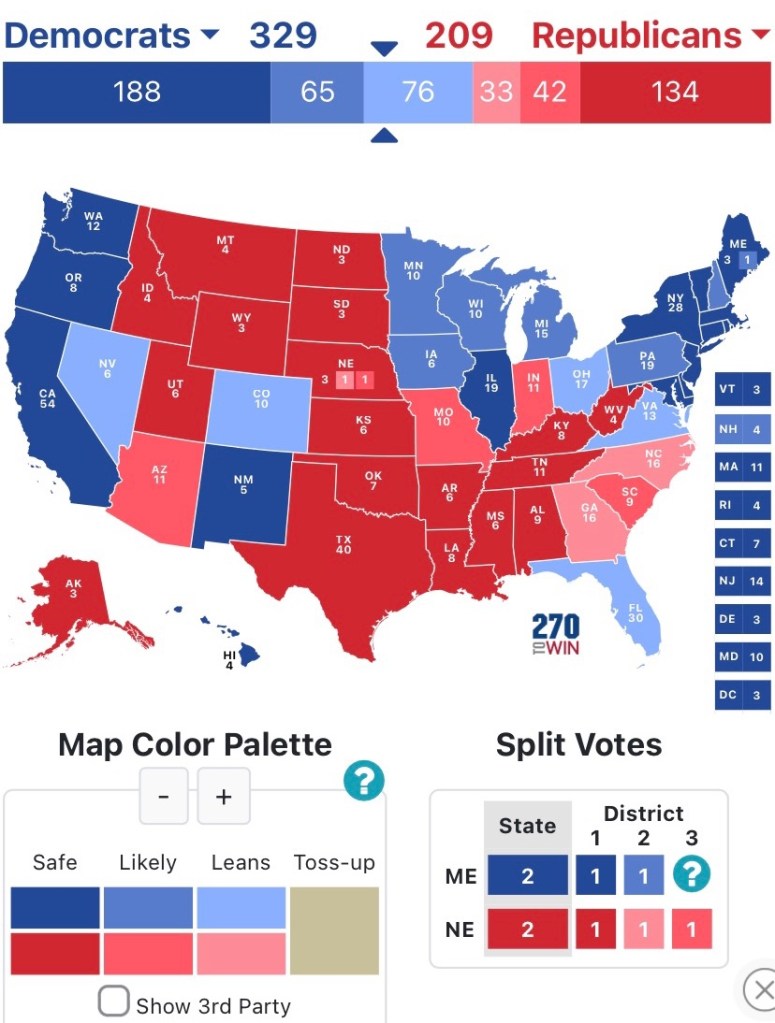
Thoughts on Why Democrats Lost in 2024

Later on today, Republicans will take control of both houses of Congress, setting up for a unified control of government when Donald Trump is sworn in as the 47th President, later this month. Regardless of what you want the Democratic Party to be, they will essentially be irrelevant in governing America soon. Parties that win elections get to govern. Parties that lose get to complain.

I’ve largely stayed out of the debate over why exactly the Democratic Party lost in the 2024 Election. The reasons for that are fairly simple. First, I think there’s ample evidence that the election should have been much worse for Democrats, based on how they did down ballot from the Presidential race (they did better), so I think I’d be wrong to sit here and tell you how awful everyone did. Second, while I think there were serious problems with the Vice-President’s candidacy, I think it’s unfair to dunk on her after the loss when she didn’t cause most of the problems. Third, while I think Joe Biden does deserve some of the blame for the state he leaves the party in, I basically reject the media’s narrative that he lost the campaign for the party, or even that pushing him out was some stroke of strategic brilliance. My general read on what happened to the Democratic Party is that the root cause of their defeat was a death by a thousand cuts, that many different factors played into their defeat. My big picture opinion is that the problems with the Democratic Party were bigger than Biden, Harris, or even campaign tactics on the trail. Democrats have a mostly systemic problem that would be painful for a lot of people involved if they fixed it.

We make campaigns really complicated and scientific, and really at the end of the day they are more marketing than data science. Whether you’re trying to grow the electorate, shrink the electorate, or whatever, your goal is to convince more people that they want to make the effort to vote, and to vote for your candidate. Most voters don’t have some long checklist of issues they care about, they’ll look at the personal qualities they want and maybe one to three issues they care about. In other words, you want to be talking to the broadest audience possible about things they agree with you on, with the most likable/least offensive messenger possible. If you’re spending a lot of time as a party on stuff that excites 45% of the population, you’re probably going to lose, no matter how well you target voters. Bill Clinton and Barack Obama were both generally likable people, who seemed to like things that normal guys liked, and ran competent governments on the day-to-day. There were a lot of people who didn’t consider themselves progressives or activists, many people who didn’t ever donate a dime, who felt fine casting their vote for them. The same could be said for Joe Biden in 2020.

The Democratic Party largely misread exactly why Barack Obama won two terms, and it has plagued them in almost every election after. It was less about changing social norms and demographic tidal waves changing the country, and more about President Obama providing cool, competent leadership coming out of a turbulent time. He wasn’t winning record numbers of Black, Latino, and young voters because those groups somehow are naturally more liberal than the rest of the population. He won them because they liked him, and he offered ideas that they liked when they heard him. I think that the misread of why Obama won has done serious damage to the party’s brand, and maybe gave a false sense of security that lead Democrats to take positions that were never going to sell. Democrats found themselves arguing the virtues of progressive social policy against conservatives, rather than going back to the faithful argument that all Americans deserve rights and security afforded to them simply as human beings. Democrats found themselves defending an open border, rather than a competent, orderly, and fair immigration process that has the resources to keep people safe. We got cornered into virtue signaling arguments about slogans like “Defund the Police” and “Green New Deal,” rather than fairness in the justice system and a clean, safe environment. Because a lot of donors, activists, and operatives in the Democratic Party wanted Obama’s mandate and legacy to be a demographic tsunami that was leading us to a rejection of white, traditionalist, Evangelical male values, we took his impressive electoral strength as confirmation that he won for the reasons we wanted him to. He didn’t. The belief that he did though lead a lot of the Democratic Party being very comfortable in a perpetual culture war that a combined majority of America either didn’t agree with us on, or just didn’t give a damn about. We spent a lot of time telling America what a bad guy Donald Trump and his supporters were. We probably would have done a lot better the last eight years talking about lowering Medicare’s eligibility age, funding public schools, and building more affordable housing. The Democratic Party lacked anything that could make a majority of America feel excited. We didn’t put forward a big idea that most people felt would improve their lives.

For sure there are other problems with the party. Our campaigns are overly bloated and inefficient, our messaging is too narrow, perhaps our candidates are too cautious. We waste our power on Capitol Hill when we win worrying about process arguments and norms. We view digital and online campaigning as largely a fundraising tool, rather than the battleground. I could go on. None of that on its own is what does us in though. If you don’t know what people like about you, it’s really hard to sell those attributes.

To the extent Joe Biden deserves blame, perhaps the timing was just bad. An 82 year old man just isn’t going to look and act like a 62 year old man. That’s not his fault, nor does it necessarily mean he was incapable of actually doing the job. Perhaps he should have run in 2016. Perhaps, given how close Kamala Harris lost, he should have never (been forced to) dropped out at all. Unfortunately, I think Joe Biden’s biggest political miscalculation in 2020 was trying to appease the numerous but small factions of people in the Democratic Party with his candidacy. Some people were never going to be happy and enthusiastic with Joe, because his brand really was different than the rest of the party. There’s a reason he looked like the most moderate guy on the debate stages in 2020- he knew better than to chase slogan politics. The unique brand that got him nominated and elected in 2020 should have been something he defiantly defended. Doing so would have given him much more space to address inflation, to address global issues, and to deal with a Congress that was increasingly dysfunctional for the latter half of his career in Washington. Governing as a fairly standard ideological Democrat boxed him in with a large chunk of America.

When Kamala Harris de facto took over the Biden campaign in the Summer, I privately told family at the time that she had no chance. Here she was, with terrible approval ratings, serving under a President with bad approval ratings, jumping into the race late, swimming uphill against the demographic history of our country (we elect white guys), and frankly her last Presidential run didn’t go great. She far exceeded my expectations of her. She was a disciplined and focused candidate, she raised money, she motivated people, and most of all, she didn’t make big mistakes. She picked a Vice-Presidential candidate who did the least harm even, a move that is almost always smart. She damn near won despite everything. About the only thing I can say bad about her was that previous Presidential campaign. Her instincts coming out of the 2018 midterms were to chase the lefty activists who seemed to have momentum in the party. Most of America was never there. Trump’s campaign effectively used her words against her. She just couldn’t quite get clear of being viewed as the average Democrat. She just couldn’t quite out run the past. Most of the reasons why (bigotry, the nature of her current job, poor media coverage, etc.) weren’t her fault. That doesn’t change the sense in hindsight that this was baked in from the jump.

The evidence suggests Democrats should have gotten blasted worse in this election. Basically every other governing party in the developed West has either lost or lost seats since the Covid-19 pandemic has faded from public view. Senators Rosen, Gallego, Baldwin, and Slotkin won swing states that Vice-President Harris lost, as did Governor Stein, while outgoing Senator Bob Casey out performed Harris in PA. House Democrats basically held the status quo. All this happened while Donald Trump won the election and the popular vote. If the Republican Party had matched his performance across the country, they would hold a sizable majority in both houses of Congress, comparable to now. This could have been way worse for Democrats. That they avoided it is worth some congratulations.

If you want people to buy your product, you have to sell them something they want. Republicans are always going to try and define the Democratic message as something terrible. The Democratic Party didn’t really push back against those perceptions. Most Americans view Democrats right now negatively. Allowing the GOP to define the Democrats as a “globalist” (such a gross term) status quo, Beltway insider, ideological, “DEI” (I know, horse shit), nerd party isn’t going to work. Marching out a collective of the same old faces and leaders, a surrogate list that still looks like 2009, and messaging points that are approved by every partner in the coalition isn’t breaking that mold.

In short, I think it’s time for some of our leading voices to take a break. Too many of our leaders listen too much to activists and donors in our party, and their views of the world just don’t jive right now with most of the people. Elections are won out where the people are, and the next generation of Democratic leaders should take the timeout we’re in to get out and meet them. Learn what the product is that they want from us, and run with it. Most people aren’t looking for a Bolshevik Revolution in America, but they do want something to be excited and hopeful for. Twenty years from now, the world will remember Joe Biden, Kamala Harris, Barack Obama, Bill and Hillary Clinton, and Nancy Pelosi fondly for the actually good governance they gave us over these past couple decades. We boxed them in though, and it’s time for Democrats to get outside of the box.

To a better 2025.

Revisiting an Old Post- Presidential Approval and Our Four Party System

I published this back in 2023, on 12/19. I got a lot of this right. This realignment wasn’t good for Democrats. Presidential approval remains poor. Non-college educated minority voters did keep moving towards Trump, while Harris actually improved with white voters almost entirely because of improved performance with college educated white men. The parts I got wrong were the importance of Dobbs and Biden winning. Dobbs did not disrupt the migration that was already going on with voters. Biden did not win, in no small part because of inflation/recession concerns and his own party knifing him up, because he wasn’t exactly what they really wanted. Kamala Harris could not unite the factions either, it turns out. Anyway, enjoy the update here.

It’s worth noting- our last two Presidents have spent most of the last seven years with poor approval ratings. When I say poor, I mean consistently under 50%, and usually handily. This is not something we’re necessarily used to- Bill Clinton spent most of his Presidency with high approval, George W. Bush spent his first term generally over 50%, and Barack Obama spent the majority of his Presidency with majority support. With that said, the new normal has become poor Presidential approval ratings, which seems to be an obsession of the press.

I think it’s worth us noting that this shouldn’t be shocking- the “right track, wrong track” question about this country has almost unanimously shown Americans saying we’re on the wrong track going back into the Bush 43 Presidency, or the better part of 20 years. Americans have not, for quite some time, thought the condition of our nation and society is improving. We live in one of the wealthiest, most technologically advanced, most militarily powerful countries in human history, we enjoy a high standard of living relative not only to the world, but to human history, and yet we’re not overly happy. The last couple of decades have shaken our confidence in so many institutions we held dear. We carry high debt, we work longer and longer hours for the same (or less) money, our marriages end in divorce (if they happen at all), addiction (to opioids, alcohol, whatever) is literally killing us, we’ve seen multiple wars in the last 75 years built on false pretenses, the Catholic Church covered up child molestations, school shootings are a constant part of our lives, universities covered for sexual monsters, our banks nearly melted down the economy, a hurricane destroyed an American city while our government looked incompetent, we spent 20 years in Afghanistan to just give it back within hours of leaving, Iran-Contra, the ridiculous Clinton impeachment, we lack confidence in our elections, Congress constantly gets us to the brink of government shutdowns, et cetera, et cetera, et cetera. I honestly can’t even remember all the stuff in my lifetime that people thought was horrible, and I didn’t even get into terrorist attacks here. It’s kind of surprising anyone thinks we’re on the right track. And I’m only bringing up the Supreme Court at the end of this list of grievances.

With that backdrop, it’s sort of surprising it took until 2017 for our Presidents to start seeing approval ratings that are under water. We began a period of political realignment with Barack Obama’s 2008 election, and we’ve been in it ever since. The net result is in-party division like we have never seen before. The Biden/Hillary wing of the Democratic Party represents somewhere between 55-70% of the party, while the Sanders wing approaches a third. The MAGA Republicans represent about two-thirds of their party, while the old Bush/Cheney/McCain/Romney/Ryan wing of the party is the other third. Nearly none of these people even entertain voting for the other party, but they basically hate the other wing of their own party. The net result of this is that virtually no national figure in American politics today has 50% of the population willing to “approve” of them. The other net result is that every Democratic Presidential nominee since 1996 has received at least 48% of the popular vote, and every Republican Presidential nominee since 2000 has received at least 46% of the popular vote. So basically the public will increasingly dislike our Presidential candidates, and yet they will basically vote for them or skip it. There’s very few actually open minded voters. There’s just a lot of unhappy voters.

All of this is a very long-winded way for me to say that Joe Biden and Donald Trump’s actual approval rating doesn’t really matter. About 90% of their voters from 2020 are going to vote for them again, no matter what, regardless of what pundits on X say. Even more to the point, even that last 10% might talk about doing something different, but 80% of them are voting the same way again, no matter what happens. National pollsters have not adjusted to an electorate that works more like the volume on your radio than a horse race. Intensity moves, opinions really don’t right now.

Again I’m making a point that is maybe lost in the explanation- Joe Biden is going to win in 2024. He’s going to win with an approval rating that probably never quite gets back to 50%. Most of the agitators to his left- be it on student loans, Gaza, or Dobbs- either live in super “blue” cities and states, or didn’t vote Democratic in 2020 (for varying reasons), and don’t represent anyone offline. Yes, this is true of the supposed “Gaza Backlash” voters in Michigan too, where Governor Whitmer last the Arab-American vote in 2022 and won an easy re-election. Trump has lead a very slow, drip of resurgence among non-white voters in general, particularly high school educated or less men, but he has more than limited his upward mobility with older white voters by putting Social Security and Medicare into question (and letting others in his party do so), and of course by Dobbs. Look, I’m going to be honest with you- Dobbs is going to decide the 2024 election. The GOP has generally underperformed a bit from 2017 on, but since Dobbs they have performed apocalyptically poorly for an opposition party in the United States, routinely losing or underwhelming in elections all over the United States. You simply cannot win an election telling slightly over half the population that they don’t have the right bodily autonomy in our society. There is no way to slice that. It cost the GOP what should have been a huge win in the 2022 midterms, it factored into abysmal performances in Kentucky, Virginia, Ohio, Pennsylvania, New Jersey, and around the country in 2023, and it simply will kill them in 2024. Worse yet for them, nominating Nikki Haley might seem like it would fix it, but both for her own extreme position on abortion, and the fact she could never get the Trump base voter to turn out for the election, she would underwhelm too. The GOP has a Dobbs problem, and virtually no silver bullet to fix it by 2024. The most angry women live in suburban swing Congressional districts, often times in the most swing states (which should be read as “suburban.”). Yes, things can happen yet. International crises. Recession. Inflation spikes (mostly from gas). A health crisis. So no, this is not set in stone. As is though, Dobbs is going to be what decides the 2024 election, and Joe Biden is in a good spot for that.

In the longer term though, this is more interesting than what I’m writing here. It may be a long while until a President has consistent majority approval. We basically live in a constant “four party” state where primaries are ideological war zones, and incumbents do not enjoy broad support within their parties. Voters are still realigning as I said before, but at a glacial pace for now. I would expect if the dam is going to break, and we’re going to see a mass migration of voters, it’s going to happen after Biden and Trump have run their final campaigns in 2024. In other words, a year from now you’ll just see the tip of the new political sun rising. College educated white voters moving left. Non-college educated voters of color moving right. This could make for significantly different politics in the near future, and serious problems for the Democratic Party. Much as Catholic voters moved substantially in the 20 years after JFK’s 1960 win, millennial and non-white voters are not going to continue to provide them the margins they gave Barack Obama. It was silly to ever think they would. Again though, these are five and ten year problems from now, not 2024. And no one should get worried about Presidential approval ratings for a while. They aren’t going to be pretty.

(Re-Published from 2023) Demographics are a (Red) Destiny

Here’s some maps for you…

2004 under the 2024 electoral vote values.
2008 under 2024 electoral vote values.
2012 under 2024 electoral values.
2016 under 2024 electoral vote values.
2020 under 2024 electoral vote values.
The 2024 outlook.

Back in the Obama years, we heard a lot about “demographics are destiny.” In fact they are, just not how those smart folks thought. There were thoughts of Democrats building huge electoral majorities as late as just after the 2012 election. The only part of that huge majority that has held as “permanent” so far is Colorado and Virginia, totaling 23 electoral votes. Democrats could probably count turning Nevada, Arizona, Georgia, and North Carolina all purple, totaling 49 electoral votes, as a somewhat positive outcome as well (Bush won them all somewhat easily). But for those 72 electoral votes, let’s be clear about what Democrats have seen slide against them. Pennsylvania, Michigan, Minnesota, and Wisconsin all blue from 1992 through 2012 and somewhat comfortable Obama wins, now are the 54 most competitive electoral votes in our nation’s politics. Florida, Ohio, and Iowa, 53 electoral votes that President Obama carried twice, are now almost certainly red moving forward. Indiana and Missouri, two of the three most competitive states in the 2008 election, are 21 electoral votes of red bastion. And of course, the promised movement of Texas to the left doesn’t look all that close to fruition. That’s 128 electoral votes Democrats thought as late as 2008 were no worse than battlegrounds that have slid away from them to varying degrees.

So the obvious question is why? An underrated part of this is Republican gains with Latinos and Black men in 2020 putting Democrats on defense. Even this though understates the bigger problem Democrats have had for a while- they put all their eggs in the demographic tsunami’s basket, and never understood what that meant under our federal system. This will become even more crystal clear in Senate elections over the coming decades. Population growth is in fact more non-white than ever before, but it’s all in a couple of states. By 2040, half the population will live in eight states, and 70% of the population will live in fifteen states. What that means in short is that half the country will elect 16 Senators and the other half (which will be much whiter and possibly have less education) will elect 84. The 70% of the country in 15 states will get just 30 Senators and the 30% in smaller, more rural, less diverse states will get 70 Senators. The United States Senate, before I am 60 years old, will be one of the least representative legislative bodies in the democratic world. While the House of Representatives, and by extension the electoral vote count for President, should at least partially move with population growth, even that won’t be perfect. Worse yet for Democrats, even if the GOP just keeps up marginal growth with non-white voters, they will keep Texas and Florida in their column for President, keeping them in the ball game to win elections if they continue doing well with white voters. Basically, if Democrats can’t change their 60 year trend line with white voters, Presidential elections remain on a knife’s edge, the Senate’s future is fairly conservative, and the House will only lean Democratic, not permanently tipped left. This is not even getting into state level governments, or what the Supreme Court will look like and do.

Demographics are not the destiny we hope for.

Why I Don’t Like the New DNC Calendar

On Friday the DNC’s Rules and Bylaws Committee formally adopted a new primary calendar for the 2024 Presidential race. The big highlights are replacing Iowa as first in the nation, instead having the South Carolina Primary go first, followed by New Hampshire and Nevada, then Georgia and Michigan. Already there are problems, including Iowa and New Hampshire saying they won’t go along, and Georgia officials saying their primary won’t move. The order will be finalized next year.

The rationalization behind the President and the DNC’s decision is actually pretty strong and realistic. No group has been more loyal to Democratic candidates than Black voters over the last 40 years. Since South Carolina began moving up the calendar, it has been growing in importance, catapulting Bill Clinton, Barack Obama, Hillary Clinton, and Joe Biden toward the nomination, and three of them towards the White House. Joe Biden said having more diverse voices pick the nominee is the principle he values. That is a very good principle to have.

I have two main problems with the new primary calendar. The first is that making changes presumes there is something broken that needs to be fixed. There isn’t. Democratic nominees have been extremely competitive in recent years, which every nominee since 1996 getting at least 48% of the popular vote. Since 1992, Democrats have won five of eight Presidential elections, and won the popular vote 7 of 8 times. None of the nominees were crackpots that took embarrassing positions either. Democrats nominated fairly solid candidates under the existing calendar.

My second problem is that there is a perceived second problem being answered with the new calendar, that the current calendar doesn’t give voice to non-white voters. It’s true that Iowa and New Hampshire are super white. It’s also true that going first and second hasn’t increased their influence. South Carolina is the undisputed kingmaker in Democratic politics. Voting fourth has allowed them to effectively end many candidates’ pathways who could not connect to the large Black voting population there. Since 1992, every Democratic nominee for President except for John Kerry, who lost to North Carolina’s Senator, won the South Carolina primary. Most of them won decisively and walked out with significant delegate leads. In Nevada, Hillary won in 2016 to get back on her feet after New Hampshire, and in 2020 Joe Biden’s 2nd place in Nevada saved his campaign. The more diverse states are already the decision makers in the Democratic Party. There’s no disputing that.

Sure, one can argue the new calendar is a bow to “new realities,” and that’s true. Iowa doesn’t look like a swing state anymore. The party is simply more diverse. The new calendar accelerates the reality we live in. Again though, why? This current early state structure nominated Barack Obama, Hillary Clinton, and Joe Biden. It elevated voices from people of color. Sure, the new calendar does that more. Are we fixing a problem by doing that though, or creating one. Leftist Bernieland voices will perceive this as an attempt to insure they can’t win, and while they should look inward and realize why that is, is that a conversation we need. The media will point out that Democrats want their nominee picked almost entirely with no input from the central and mountain time zones, or by coastal states, basically. Swing state New Hampshire and quasi-swing state Iowa will almost certainly rebel and lose a chunk of their delegates. And frankly, if Michigan and Georgia are in for being swing states, why aren’t Pennsylvania and Arizona? We’re opening a lot of cans of worms here, for marginal improvement in the process.

I love the principles being displayed by these moves. I can’t find the problems they’re trying to fix. I can clearly see the problems they will create.

A Letter to my Republican friends

I hope my Republican friends reflect a bit on the state of their party. America needs two functional political parties to work, and we don’t have that right now. Exit polls showed Joe Biden’s approval in the low to mid 40’s, depending on the state. Republicans should have been able to turn that into a victory, but couldn’t. That is a commentary on the GOP. Doug Mastriano and Dr. Oz aren’t acceptable people, let alone candidates. Herschel Walker is a national embarrassment. People don’t want to put Marjorie Taylor Green or Jim Jordan in charge of a bingo game, let alone a house of Congress. And the Dobbs decision, let alone talk of banning contraception or marriage equality, is simply unacceptable to a majority of Americans. People probably would have liked a plan on gas prices beyond “drill, drill, drill,” but you never put that forward. You’ll probably narrowly get the House for two years, but that’s gone in two years when a Presidential electorate votes in New York, so enjoy it, and you’re not getting the Senate next year. There’s room for a Conservative party in America certainly, but I think the point is the freak show needs to end.

Have a great day, and Merry Christmas and Happy Thanksgiving,

Rich

I Waited a Long #*^%ing Time For This.

It was an August evening 18 years ago that I came back to my dorm from cross-country practice and saw a flier on my door advertising internships with the Pennsylvania Democratic Party’s coordinated campaign for future Governor Ed Rendell and Congressional nominee Ed O’Brien. Motivated by my anti-war, pro-union, pro-environmental views of the day, I called the number the next day, and was on board within the week. I did not know at the time that my sports career, which had been ongoing since I was five, was days away from being ended by mono, or that I’d still be doing campaigns 18 years later (which was definitely not my intention at the time). In hindsight though, the transition makes sense and meant the world for me, as politics both replaced my competitive needs, and made me grow in ways I did not suspect it would at the time.

To be clear, 18 years later I could (and plan to) write a book about all the ways I think our political process sucks, and is broken. I often find myself feeling contempt for every part of the system, even as I would say without a second thought that this same broken system has made me a better person, and taught me to empathize with people I would not have had much in common with them. Politics is complicated though, so it’s fitting for me that I’m standing here all these years later observing that my own relationship to it is extremely complicated too. Ultimately though, it has been rewarding.

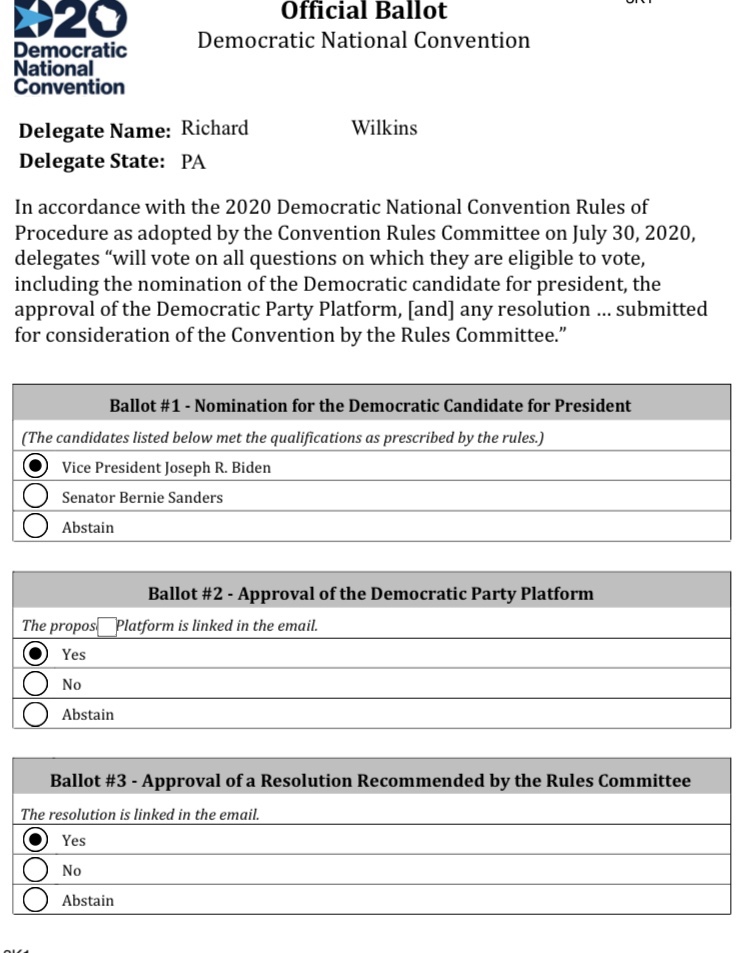
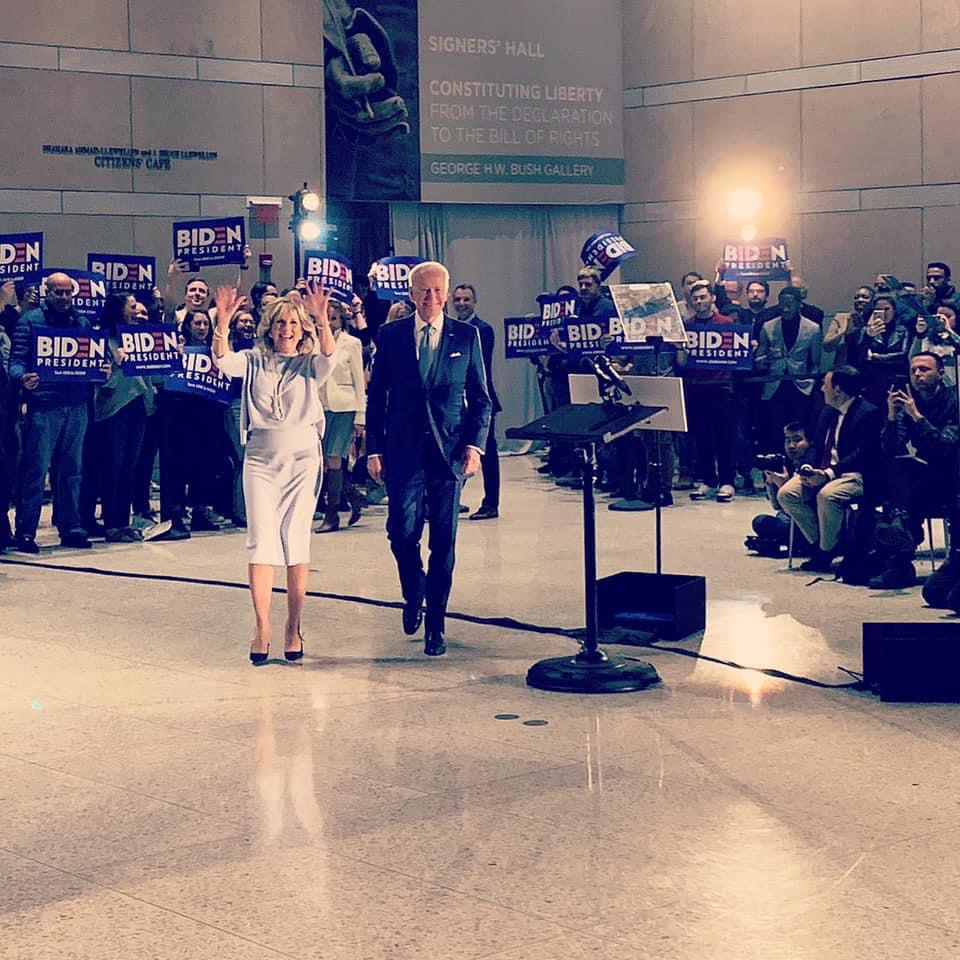
I can’t say I’ve ever had a bigger reward than the one I’ll celebrate this week: national Delegate. Thanks to the Biden campaign selecting me, about 300 people signing my petition, Joe Biden winning PA-7, and slightly over 50,000 people voting for me, I have the honor of a lifetime this week. Yes, it’s a weird year and convention, and I would be lying if I didn’t express my disappointment with not being in Milwaukee this week, but don’t mistake that for me being disappointed in the moment. I’ve spent my entire career working with a chip on my shoulder, that I’ve been passed over or underestimated by people in this industry for varying reasons. This week I can quietly and proudly tell myself I’m good enough, and for the nominee, no less. This is first line in your obituary type of shit here.

Without question, the best night of the campaign.

To be honest, I kind of thought this moment in my political life would happen four years ago, for Secretary Clinton and her campaign. I was an alum of her 2008 campaign, the convention was in my adoptive city of Philadelphia, I was raising money for her campaign and “Ready for Hillary” very early on, and I had friends and allies in close enough contact to them that I was pretty sure my call was coming. I received only small offers early on though and got passed over to be any kind of delegate for Hillary. It was personally and professionally very disappointing, and left me questioning many of my decisions. I got that my fairly extreme lack of diversity (white, straight, Catholic, male, geographically outside of the big cities) was a drawback, but why did it seem like I had nothing to offer a candidate that I admired like none other? The disappointment made me look in other directions, but ultimately I did stick with Hillary, and after the 2016 convention, they suddenly needed me to parachute into Northeast North Carolina to fix a messed up region for them, for which the honor will forever be mine. I made great friends there, and our hard work as a team gave the Tar Heel State a Governor and Attorney General that have improved so many lives. Ultimately though, even that experience left me and so many others feeling empty when Hillary came up short. It was devastating.

The last three years have been a whirlwind, and the experience has changed me politically like it has for so many of you. That all came to a head just two days before Thanksgiving, when I text an old friend who was Vice-President Biden’s head guy in Iowa after reading about him in an article. It would take until nearly Christmas, and I very nearly went in another direction, but I was offered to come to Omaha, Nebraska and join the Biden team as the out-of-state organizer there, and I accepted. I left the day after Christmas, ultimately spending 40 nights in the Midwest, fighting for Joe in Iowa. My role expanded to handling paid canvassing in Southwest Iowa and working with endorsers to fill our precinct captain team out, and it’s fair to say I was kept busy. I would not change it for the world though. Friends of mine, from Senator Casey’s political director to friends from past campaigns, and even people I met on twitter or knew from back home in Easton came out to volunteer for us. The personal highlight of all highlights was when my first major political boss, Senator Chris Dodd came to campaign with us over the last weekend in Council Bluffs (and his caucus day “good luck” call was awesome too). The whole experience was amazing, and during that time period I was informed that I had been selected to be a delegate (with a gigantic assist from Senator Casey’s political director, again). Honestly, even seeing that things weren’t looking great, I had prepared myself for a tough caucus night, and likely being laid off the day after. I got the tough caucus night, and handled it as best I could. Then I got the shocking call that I was being re-assigned to Philadelphia. For the next month, I don’t know if I was only lucky, somewhat good, or some combination, but I could not miss. I woke up every morning on Broad Street of my favorite city in the world, got my Friday night cheesesteaks, got visits from old, close friends I hadn’t seen in years, and oh yeah- things got better. To be honest, I have no idea how I got assigned to digital organizing, it was literally something I had never done in my career (maybe the only thing), but the success was there. My biggest two wins were Oklahoma and Tennessee on Super Tuesday, but the wins continued to just pile up in states I was organizing in- Massachusetts, Idaho, Wyoming, Maryland, Pennsylvania, New Jersey, Ohio, and Delaware- all states I either organized in on the digital team, or later on the Mid-Atlantic “Pod.” Obviously Covid-19 struck about a month after I arrived in Philadelphia, the primaries came to a conclusion earlier than expected, and I was re-assigned eventually full time to Pennsylvania, but there was so much winning- and that was a great feeling. None of that was better than being elected to the convention on June 2nd though, so here we are.

From an identity standpoint, obviously Joe Biden is the best fit to me politically that I’ve probably ever had. It’s a lot more complicated than that though. In 2007 I passed on an interview with his campaign, which was offered to me just two days after I had accepted an offer from Senator Dodd. In 2015, I had the contract in hand to go to New Hampshire for the Draft Biden movement, and ultimately life events gave me second thoughts that kept me with Hillary. Even now, I can’t say this campaign has gone according to script. I also can’t say the similarities I share with Biden are what actually even draws me to him either- his Pennsylvania roots, his Catholicism, his “working class” politics- none of that gets me. I think it’s just how real of a person Joe is. He’s achieved great things, but his life has been far from perfect. He’s suffered personal loss. He’s made damaging gaffes. The “smart” people have consistently dismissed his politics and some even have called him dumb. This is part of what I love about Joe- he’s smarter than the “know it all” types, because he can relate to normal people, he keeps a broad, open tent, and he lets his opponents keep their dignity (which is why they’re opponents and not enemies). When this is over, and it’s 1/20/21 and I’m telling you “I told you so,” remember this is why- the country desperately wants to have a normal human being be it’s leader, someone that can wind down the permanent culture wars we’ve been fighting since Newt Gingrich decided to make all politics as nasty and personal as he could. Joe Biden is genuine, he is decent, and he is a bigger man than the rest of Washington, and I’m only so thrilled that he and I both hung around the business long enough that I could say yes to his campaign, finally.

The first convention I was at, in 2004- a State Senator from Illinois.

Tomorrow will begin my third convention I have attended, my first as a delegate. My father and I drove up to Boston for the first two days of the 2004 Convention, and met this former State Senator from Illinois that you may have heard of named Barack Obama on Boston Harbor, speaking at a League of Conservation voters event the morning of his far more famous convention speech. In 2016 I spent the Philadelphia Convention outside of the hall as well, instead attending the parties and happy hours where you meet everyone. I would be an unequivocal liar if I said I’m not disappointed that I’m in Easton and not Milwaukee right now. There is zero doubt that I would have done anything possible to have the full delegate experience. Unfortunately life dictated otherwise though, so we’re going to do our best to enjoy the moment. I’ll attend the Pennsylvania delegation’s events, watch all the speeches, and attend the Labor caucus meetings (and any other caucus meetings I belong at). I voted for Joe Biden, our platform, and to continue under the post 2016 unity rules. Hopefully we delegates will get to register our support for Senator Harris with some form of vote, for history’s sake. I’m going to treat this convention seriously, because I waited a long f**king time for this. 18 years to be exact. And while no one is owed the opportunity to do what I get to do here, I earned it as much as anyone. I survived all that time, and the 9th position on the ballot in a low information race, for this. So yeah, I’m spiking the football just a bit.

Like our nominee I’ve got plenty of flaws, but also like him I’ve tried to not forget where I came from. I’m really proud to take part in this process and nominate a President we can really be proud of as a person again. I’m fortunate to be here, and fortunate to work for this man, and be a delegate. I remind myself that my immigrant great-grandfather walked across a railroad bridge from New Jersey to Pennsylvania to work in a cement factory with a bunch of other immigrants, then did it again the next day. I get to work for the 46th President of the United States, and represent the Democratic voters of Pennsylvania’s 7th Congressional District to vote for him at the Democratic National Convention. I’m thankful for the moment.