
Photo of the Day, 4/1

Hm, what’s going on in the world? Apparently a lot. I just wish it was a lot less.
Let’s start with some fun stuff. As Kristi Norm departs as Secretary of Homeland Security, we are finding out that apparently her husband is a crossdresser and maybe gay. Look, I think he should be whatever he wants to be, but his wife’s political stances on the subject are hypocritical and fair game. And perhaps we know why she was supposedly sleeping around. Meanwhile fringe nutjob candidate for Florida Governor, James Fishback, is claiming that looney-tune wacko Laura Loomer is a man. This is some crazy shit, but if you search “Larry Loomer” on X/Twitter, you’ll find that there is an audience that believes this stuff with their whole hearts and minds. Loomer says he’s an Islamist. This shit is incredible. Meanwhile in Nebraska, a Republican Pastor is running for U.S. Senate as a Democrat for whatever reason. I guess he had a genuine change of heart. Fresh off of being hacked himself and having all of his info put on the internet by Iranians, Kash Patel is ordering the release of files pertaining to Congressman Eric Swalwell’s supposed affairs with a Chinese spy years and years ago. Swalwell is currently running for California Governor. ICE Agents will be posted outside Marine Corps Boot Camp graduations to check if family members are documented. Lots of people are talking about streamer Hasan Piker, I’ll just remind you that he allegedly abuses his dog. Big emphasis on allegedly. He also yells at some Asian lady and doesn’t care about Black people. Great guy. In much more sane news, the bullet that killed Charlie Kirk can’t be matched to the alleged weapon that killed him. Yep, totally normal shit. Olivia Nuzzi’s ex, former Congressman and Governor Mark Sanford (of “hiking the Appalachians” fame.) is back, running for Congress. Student Loan forgiveness is basically dead. I guess Elizabeth Warren was wrong about doing it by Executive Order. Who could have known? PBS and NPR got temporary life from a federal judge. Good news.
Remember the “Bowling Alone” book? Well, it turns out that “Big Bowling” is literally trying to finish the story. Bowlero, the largest operator of bowling alleys in America, is basically buying bowling alleys and eliminating their local leagues to make room for higher income players. Sounds a lot like housing. Anthony Edwards didn’t start last night because he had to take a shit. No lie. Jason Kelce is working the Masters. Hell yeah. It’s Final Four weekend and Duke isn’t in it. That’s good. Arizona seems to be the favorite, but never count Hurley’s UCONN out. The UCONN women lead the women’s field, and they meet South Carolina in the annual war on the court, while UCLA and Texas meet in the other game. Baseball began with an opening night on Netflix. I actually liked it. I like NBC’s Sunday night set up too. Check back in a couple weeks for strong opinions of anything we’re seeing right now. If you look right now, Bryce Harper and Shohei Ohtani suck. Enjoy that if you’d like. Some guy named Wiemers started 10-for-10 for the Nationals. Move over, Mickey Mantle.
I didn’t mention Iran this week. It’s not going great for anyone. We’re bombing the shit out of them, they’re closing the Straight of Hormuz, so gas is way up, and they’re fighting back with drones. I mean, I wonder how long it is before Trump either loses interest or does something insane?
And finally, it is Easter Week. Whether you celebrate the holiday or not, enjoy the time.
If you’re still stumbling, you drank too much. Happy week after St. Patrick’s Day. They told me not to, but I did. I took Florida in some brackets, Arizona in others. Figures that the one who is the defending champions were the ones who burned me. March Madness gave us the expected, such as Duke, Arizona, Michigan, Michigan State, and UCONN, and little to no fun. For the second straight year, and second time in the modern era, all the teams in the Sweet 16 come out of The Big Ten, SEC, ACC, Big 12, and Big East. In the era of the portal and NIL, good players leave mid-majors after two years to go play on power programs. Hey, at least we have St. John’s. At least it’s not the women’s tournament either, which is basically just UCONN, UCLA, and South Carolina dogging teams until they get to each other. Texas and their enormous athletics budget arrived as a #1 in the women’s tournament too, and has lived up to it, while their men won three games last week. Local teams Lehigh, Villanova, and Penn all got run out of the men’s side as well. Villanova and Princeton’s women were both sent packing too. Unrelated, but I lost every parlay I tried.
Penn State won the NCAA Wrestling title in the least shocking result ever. Meanwhile, Venezuela beat the United States in the World Baseball Classic final. I guess we take their President, they take our trophy. Cuba probably won’t get to keep either for themselves. Despite some socialist white kids from the U.S. visiting, the country is imploding under it’s own weight. Yes, I know we’re blockading them, which we basically have for 70 years, to varying degrees. Anyway, back to sports, Opening Day for MLB is on Thursday. I’m obviously quite excited, but you’ll get my predictions later this week. I’ll be at a AAA game on Saturday to see Zack Wheeler rehab and the Phillies and Nats on Monday. I’m more excited for betting my pitcher strikeout parlays again. I win on those most days.
In case you were wondering, we’re still fighting the war we won a couple of weeks ago in Iran. The Straight of Hormuz still isn’t open and the national average of gasoline is $3.97 a gallon, because Joe Biden. Israel is still fighting Hezbollah in Lebanon, as well as kind of fighting Hamas in Gaza, and fighting Iran in Iran, which only makes sense when you realize the same people are funding Hezbollah, Hamas, and Iran. Here at home the Homeland Security Department government shutdown continues, and TSA is a mess. I mean, Al Jazeera calls it a crisis. Workers haven’t been paid in weeks, and some just don’t even show up for work now. Can’t say I blame them. President Trump wants to really fix this crisis, so he’s sending in his “A Team,” putting ICE at airports across America. In other mildly political news, Robert Mueller, the former FBI Director who investigated Russian interference in our 2016 Election and determined it happened and that the President couldn’t be prosecuted for it, died. Yes, Donald Trump celebrated it. He did not celebrate Chuck Norris dying though, though I doubt he knows he was a conservative Republican. It’s a real party in the USA these days.
The Bachelorette was canceled for this season. Apparently Taylor Frankie Paul, the star for this upcoming season, beat the living shit out of her ex/baby daddy, and the video leaked. Look, shit no one is proud of happens sometimes, but hear me out. A few dozen (?) “men” were going to go on a show and share a girlfriend for a few weeks, begging for love from a woman who will kick their ass when she’s pissed. The cucked American male is simply wildly out of control. Like, don’t you have any respect for yourselves? Don’t answer that. Apparently some guy who was on the show named Brad Ledford was actually the driver of the car that crashed into former North Carolina Congresscritter Madison Cawthorn and put him in a wheelchair. Seriously, first you picked the violent mom from “The Secret Lives of Mormon Wives” as the prize of the show, then you put these clowns on the show? This show wouldn’t be crazier if it were cast in a halfway house.
Have a nice week everyone. Enjoy!

If you want to know where you’re going, you need to know how you got there. The Democratic Party is in a seeming civil war right now. This week it was Illinois, last week it was Texas. On one side, the Biden/Clinton coalition of voters from 2016/2020 and on the other, the Bernie Sanders/Elizabeth Warren wing. The actual policy differences in the two are only marginal, really. Both favor expanding health care access, fighting climate change, funding things like public education, and access to reproductive health care. The disagreement is largely based on details and how far to go, from a policy standpoint. Philosophically they are different though. The Bernie/Warren wing of the party wants to build a Democratic Party that resembles a European Green/Social Democratic Party, or British Labour under Corbyn. The Clinton/Biden voter wants a more center-left party. How did we get here and how do you square the two?
To understand the modern Democratic Party I think you need to go backwards and start at there different dates- 1966, 1992, and 2006. They are actually not similar elections at all. Two are midterms, one a Presidential. Democrats won in 2006, while 1966 and 1992 are a mixed bag in many ways. So why these years? I’ll start with 1966, because to me it’s the beginning of all modern politics (not that nothing mattered before that, but nothing should really be viewed as modern). 1966 was the first election after the passage of LBJ’s Civil Rights agenda in Congress. It was the beginning of Democrats decline among white voters that truly culminates in the Reagan years, then relatively stabilizes with Clinton. Democrats started to see some losses in 1966. Many folks like to attribute Johnson’s fall in popularity with Vietnam, but any honest analysis tells you it was mostly otherwise. In 1968 the nation would move to electing Nixon on such themes as “the silent majority,” “law and order,” and eventually “peace with honor.” White voters began their move in 1966, but accelerated it in 1968 and especially 1972. Watergate did interrupt Republican dominance in 1974 and 1976, but by 1980, 1984, and 1988 Republicans were carrying Catholics, running 60% neighborhood numbers with White voters, and carrying the Midwest. They also began eroding the “Solid South” Democrats had enjoyed since the Civil War, which ultimately culminated in the 1994 takeover of Congress, but really took hold under Reagan. In fact, 1966 was the “canary in the coal mine” that foreshadowed Republicans winning five of the next six Presidential elections. Obviously that takes me to 1992 and Clinton. Clinton was the first Democrat to truly reap the benefits of the growing support the party had from Black voters. He also made gains with “soccer moms” and other “normie” voters who were alarmed by the “Christian Coalition” and other culture warrior conservatives. Bill Clinton pulled in white moderate voters and majorities with most non-white groups. Clinton largely abandoned the ideological left of the 1960’s politically. Clinton’s White House was less progressive dogma than his Democratic predecessors, even if that is a bit embellished by some (see his 1993 budget). Sure, Clinton invested heavily in education, the environment, and “built a cabinet that looks like America,” but he also did welfare reform, balanced the budget, was a free trader, and had “Sista Soulja.” Clinton aimed for broad appeal that made him less popular with left-wing academics, ex-hippies, and ideological leftists. He was really popular too, sitting in the 60’s through the end of his term amidst an economic boom. Clinton was personally problematic though. He had the Lewinsky affair. His Vice-President ran for President and lost a very, very controversial election. And probably most importantly of all, his wife became the first ever First Lady to run for office herself after the White House, winning a U.S. Senate seat in New York, which was of course not Bill’s home state. Of course we know the early 2000’s after Clinton were a tumultuous time as well, with 9/11 and the Iraq War dominating much of the discourse through the 2004 Election. And that pretty much takes us up to modern times.
The third year I put in there was 2006, and 2006 is truly the beginning of what the Democratic Party is now. George W. Bush was deeply unpopular by 2006. Iraq, Katrina, a failed Supreme Court nomination, and an attempt to privatize Social Security had worn him down. The Democratic Party was almost identity-less at that point though. The party’s last two Presidents, Carter (defeated) and Clinton (problematic personally) were memories by then. The last two House Speakers who had been run out of office in defeat (Jim Wright of Texas had been forced to resign and Tom Foley of Washington was defeated in his re-election). Tom Daschle’s brief period as Majority Leader in the Senate was a bad memory (Iraq, the Patriot Act, his own defeat in 2004). The Supreme Court had been narrowly conservative since the Reagan-Bush period. The party had no recognizable national leader really. And yet, the party won, and won a lot. Democrats took both houses of Congress in a wave election. Nancy Pelosi became the first woman to lead Congress as Speaker. Moderate mormon Harry Reid, a marginally pro-life Nevada Senator took over the Senate. Democrats took the House winning in places like Suburban Pittsburgh, took the Senate by flipping states like Missouri, Montana, and Virginia, and won Governorships in places like Ohio. This wave in non-traditionally blue areas set the stage for 2008 and the birth of today’s Democratic divisions, in part because the Democrats basically won Congress without a real ideological direction. They ran talking about the minimum wage, the war, health care, and ending corruption. It wasn’t exactly a far left manifesto.
A lot of people have revised the history of the 2008 primaries to fit their narratives that emerged after 2016. First off, the race was essentially a one-on-one race from New Hampshire on. Barack Obama’s coalition was built largely on Black voters, young voters, and progressive white voters. Hillary Clinton dominated among rural voters, older voters, and Hispanic voters. These coalitions dramatically changed by 2016, and even again by 2020. While Clinton won women on the whole pretty solidly, she lost young women in her 2008 run, and Black women. Obviously that was different in 2016. Obama’s coalition didn’t really crack based on age at all. Hillary continuously won in primaries, Obama won caucuses. Opposition to the Iraq War was a huge selling point for Barack Obama, particularly with lefties and young people. Obama’s coalition more closely actually resembled Bernie Sanders campaigns, and yet he was able to win. That was largely a product of Black voters sticking by him loyally. That’s about the only theme from that primary that holds up moving forward though. The rest of his primary coalition essentially forms the backbone of today’s populist left.
I think it’s fascinating to guess as to why most of the groups in the Obama coalition moved from him in 2008 to a more combative populist by 2016. There’s not really an obvious reason. Barack Obama, even today, polls as the most popular Democratic politician in the country pretty easily, and across most ideological spectrums. Some surmise that he wasn’t tough enough on Wall Street after the 2008 crash, or that he didn’t deliver a “public option” in Obamacare, or that he didn’t get out of Afghanistan and close Guantanamo, or all kinds of other theories of his shortcomings, and yet there’s not an ounce of data in polling that suggests these voters soured on Obama even a bit in his Presidency. Interestingly it does seem that Clinton’s coalition did crack quite a bit on their support of her. The more rural Democratic voters who had supported her in places like West Virginia and South Dakota joined young voters and progressive white voters in backing Bernie Sanders in 2016, while Black voters joined older voters and Hispanic voters in backing Clinton’s 2016 primary campaign. While Obama’s poll numbers stayed strong, something clearly had moved within his original base by 2016. Not only did a lot of his coalition move to Bernie, a fatally sizable portion of progressive whites, young voters, and even Clinton’s 2008 rural base either moved to Donald Trump or didn’t vote for her. While she got virtually the same amount of votes as Obama got in 2012, and won the popular vote, Clinton lost the election. Florida, Ohio, and Iowa moved comfortably right into Trump’s coalition. Pennsylvania, Michigan, and Wisconsin moved towards Trump by the skin of his teeth. Clinton narrowly hung onto Maine, New Hampshire, and Minnesota. Obama had won all nine of these states both times, and rather convincingly for the most part.
The thing I find interesting about 2016 is that it really wasn’t supposed to happen. The progressive champion of the moment in 2015 was Elizabeth Warren, and she simply missed her moment in time to try and run for President. Joe Biden was probably the most bullet proof candidate the Democrats would have had at that time, and most of official Washington dismissed him as a candidate. There were some dead-ender “normies” that thought Martin O’Malley was a real alternative to Hillary, but basically the Beltway was ready to hand her the nomination. Bernie Sanders had some real people in Iowa and New Hampshire, but his national campaign apparatus didn’t read like a powerhouse. Republican operatives thought they were going to get a battle between Jeb Bush, Marco Rubio, and Chris Christie, almost all of them thought Trump was a joke. Bernie and Trump were literally no one’s idea in DC. Then our politics turned on it’s head.
Of course 2018 did happen, but it now looks more like an anomaly than a sea change in our politics. Democrats made a real pivot towards nominating women for Congress in the aftermath of Hillary’s defeat and managed to take the House this way. Of course, Democrats had cultivated no new leaders in the time from 2006 until 2018 though, and Pelosi was back in the Speaker’s office. Pelosi is probably the closest thing to middle ground between the left and center in the Democratic national leadership, but even that isn’t neutral. 2018 brought a new majority in the House of Obama/Clinton Democrats, but also brought about “The Squad,” and did little to assuage the oncoming 2020 nomination fight.
The early portion of the 2020 primaries was a mirage. Joe Biden eventually was nominated by dominating with a coalition of Black, Hispanic, rural, and older Democratic primary voters that was both more moderate and yet more broad than Clinton’s. In the early going states of Iowa and New Hampshire though, he struggled while splitting his electorate with Pete Buttigieg and Amy Klobuchar. Once he edged them out in Nevada for second though, he consolidated his electorate in South Carolina and ran away with the nomination by the widest margin since Kerry in 2004. Bernie Sanders had some early success before fading, building largely off of a coalition of younger Hispanics, younger voters in general, and progressive white voters. Bernie also faced problems early on with splitting his vote, particularly the progressive female portion of it, with Elizabeth Warren. The other obvious weird part was Covid essentially interrupting the primaries shortly after Super Tuesday and making the primary seem to be over. Even so, Biden had built a substantial lead after Super Tuesday and lead every poll at that point.
Biden went on to win the 2020 election with the broadest coalition in American history, getting 51%, over 81 million votes, and 306 electoral votes. Democrats won the Senate and made Chuck Schumer the Senate Majority Leader along with Pelosi still leading the House. From there, things sort of went down hill. In 2021, Roe v. Wade was overturned, setting off rage within the Democratic ranks. In 2022, despite rising inflation and Biden’s unpopularity, Democrats lost single digit seats in the House, despite losing the popular vote by over 2 million votes and ultimately narrowly losing the House. Frankly, the defeat looked way better than it actually was, and the loss was foreshadowing of what was to come. Biden’s popularity continued to drain over economic concerns and worries about his age. He ended up dropping out in the middle of the 2024 Presidential race, despite what was essentially a margin of error deficit in the polls. He was largely pushed out by major donors, many of whom had been fans of his as Vice-President and even as a Senator. He was replaced by his Vice-President Kamala Harris, who immediately attempted to moderate her image more towards that of what Biden’s had been in 2020. She talked about her time as a Prosecutor, talked about fighting inflation, attacked Trump as an unacceptable, authoritarian figure, and tried to appeal to moderate voters with endorsements from former Republican electeds like Liz Cheney. Harris leaned into the image of a tough prosecutor type, something she had leaned far away from in 2020 when supporters of Bernie Sanders and Elizabeth Warren called her a “cop.” Republicans pushed back, seeking to use her 2020 campaign statements to cast her as a far left liberal and continuation of Biden’s policies, which by then they had cast as more liberal than he ran as. They hammered her on support for transgender people, support for a liberal border policy, and support for Biden’s economic policies. Data says it worked. While Harris bled out less votes from her own base than Hillary had in 2016 (it’s true, the left really did vote for her), she lost a lot of moderate Biden voters. Some flipped. More didn’t show up.
All of this brings us to today. The Democratic Party’s “brain trusts” in DC seem to be moving the party in a very different direction suddenly. They seem to think the way to bring back the “missing” Biden voters is to move which voters they are prioritizing with their messaging. Most of the front-runners for the 2028 Presidential race that are being created by DC consultants and the media are white men, many of them Governors. So in this group, think Shapiro, Newsom, Pritzker, Beshear, Gallego, and Murphy. The other group getting attention are non-white populist progressives such Ro Khanna and AOC, and while he’s not a Presidential contender, Zohran Mamdani is a figure they are pushing. Then there is a whole other element of candidate rising amongst the consultant class- the “white masculine man” that is going to bring back appeal to white men. This is a solution in search of a problem. as Kamala Harris actually did better with white men than Biden, Clinton, or Obama, even winning the college educated white men. Even so, we’re seeing the rise of candidates like Graham Platner, Bob “Crooksy” Brooks, and James Talarico. Even worse, the white guy governors seem to be embracing this crap too. Newsom is going to go on human pile of dogshit Hasan Piker’s podcast to talk. Shapiro is endorsing Brooks. Senators such as Gallego, Murphy, Heinrich, and Whitehouse are embracing Platner. The fix is in. They want to go all in on “manly” white men as their path forward. What problem does it solve? I’m not sure. They’re doing it though.
I think the clear thing to understand is this isn’t the party’s top problem, but the party’s lack of appeal to white people is a problem. If states like Ohio, Iowa, and Florida are out of reach, and states like North Carolina, Georgia, Texas, Arizona, and Nevada aren’t firmly in the win column, the map tilts conservative. The reality is that further erosion could take Pennsylvania, Michigan, and Wisconsin out of the Democratic column for good. Even more succinctly, while half the country is going to live in like 8 states that will be more diverse, the other 42 states are going to be decidedly white. The Democratic Party’s decline with white voters largely has stabilized for a quarter century though, and Kamala Harris did better with white guys than one might have guessed. I’m not sure what in our modern history suggests that we need to nominate Neo Nazis, crooked “every” men, and people who go on conspiracy podcasts in order to win? We got more votes than anyone in history in 2020 by running a moderate guy who had solid appeal to Black voters and didn’t seem like an extremist nut to white and rural voters. We’re risking our strongest bases of support- Black voters, Jewish voters, and educated White women to appeal to who exactly? The descendants of people who moved away from the party between 1966 and 1994? The last few Dixiecrats who ran away in 2010? People who came out of nowhere to vote for Donald Trump in 2016, 2020, or 2024? Do we really think going on Hasan Piker’s ridiculous podcast is going to make us look normal? Didn’t we learn our lesson from thinking normal people listened to Charlamagne? What in the last 60 years of the party makes us think we can get votes from people who don’t vote for us by being more like a New York City Mayor who won’t oppose saying “Globalize the Intifada?” Sure, I do think Democrats overreached with trying to normalize and formalize DEI, #MeToo, and other social movements that the country wasn’t ready for at this time, but are we now going to embrace terrorists and Nazis to chase mythical votes we haven’t received in decades? It should be worth noting that the only group to support eversuccessful Presidential candidate in recent times on the Democratic side are Black voters. Jewish voters are the only other group to support every Democratic Presidential nominee in recent history. Wouldn’t any modest gains made with guys with Nazi tattoos chopping wood in the rural South be offset with the losses we’d take with our base? Seems so to me.
Anyone to study recent American political history understands that the ideological left Democratic Party broke up as the electorate included more and more women, and Civil Rights finally let Black voters vote. Race and gender simply trump ideology in the American electorate. One that wants an ideological party could put in the time to organize and build support for their positions, maybe even try to pass some legislation that moves the ball forward towards their position. Instead, some think the right idea is to wholesale try to turn 60 years of political movement around by embracing lunatics and bigots. It’s a horrible strategy. It’s tone deaf. It’s historically ignorant. It’s a path to losing the 2028 Presidential election. Tread wisely, friends.
You know how sometimes a lot of stuff happens in a week, but really nothing stands out so you really don’t remember anything? Good times. It’s almost Spring. It’s St. Patrick’s Day tomorrow. No matter how bad life is, it’s good right now. Or it could at least be worse. It could still be early February and there could be snow on the ground. Lots of snow, frozen solid because it’s too cold to melt.
So March Madness is here. Locally, Lehigh University is in the big dance, as are two Philly schools, Villanova and Penn, while St. Joe’s is in the NIT. It seems like most of New York City is in, with St. John’s, LIU, and Hofstra in. I haven’t filled out my brackets yet (that’s tomorrow morning), but I think I’m split between Florida and Arizona at the moment, but also considering Duke. Here in Easton, PA, we celebrate March Matness religiously, with this week’s NCAA Division I Wrestling Championships almost being a religious holiday. I’m taking Penn State to win by a million. In the World Baseball Classic this week the United States and Venezuela have advanced to play a championship game tomorrow night filled with geopolitical irony this year. Phillies Cristopher Sanchez, Aaron Nola, and prospect Dante Nori have all stood out for their teams in this tournament, while Phillies Americans Brad Keller, Kyle Schwarber, and Bryce Harper will play in tomorrow’s final. I’m enjoying it. This past weekend was the New Jersey State High School Wrestling Championships, and while the wrestling was good, two tweets stood out- this one about the best Italian names in each weight class and this photo of an amazing scene at the end of a semi-final match on the IBEW Local 102 mat. Peak stuff. Also if you ever thought of giving up on something, 33 year old Izzy Balsiger became an All-American 13 years after previously achieving the honor at the NCAA Division III Wrestling tournament.
In more serious matters, the United States suffered casualties in a war that it won a week or two ago in Iran. The U.S. Embassy in Iraq was hit by a drone. The President is pressuring NATO and China to reopen the Straight of Hormuz. Gas prices are up. Israel is talking to Lebanon as it increases it’s ground campaign in Lebanon against Hezbollah. White House Chief of Staff Susie Wiles has breast cancer and I wish her a speedy recovery. FCC Chairman Brendan Carr has threatened to revoke licenses for television networks that don’t cover the Iran War the way he likes. Congress doesn’t seem super pleased, but they can’t get themselves out of a paper bag. A federal judge has blocked parts of RFK Jr.’s vaccine guidelines. The USDA is making indentured servitude great again, deciding to increase temporary visas for immigrant migrant farmworkers and lower their pay. There are major primary elections tomorrow in Illinois and apparently Altoona, if you believe that. New York City is lowering speed limits to 15mph in school zones. I’m fine with that.
Last night was the Oscar’s. I watched Conan’s opening monologue and thought it was pretty funny, but Conan O’Brien is funny. “One Battle After Another” won best picture. Jessie Buckley won best actress for her role in “Hamnet.” Michael B. Jordan won best actor for his role in “Sinners,” officially making him the second most famous Michael Jordan. “Sinners” won four Oscars as a movie, while “One Battle After Another” won six. Nicole Kidman showed up Jeff Bezos and Lauren Sanchez on the Red Carpet. And in my favorite win, “Mr. Nobody Against Putin” won best documentary feature, a big fuck you to Vlad. I still couldn’t sit there and watch the whole show though, ADHD gets in the way.
Well it’s just about St. Patrick’s Day. Go drink a green beer or some Guinness, throw on your Birds jersey for the day, and blast the Dropkick Murphy’s. Oh, and eat all of the corned beef and cabbage that I don’t get to first.

Two things happened yesterday that are only sort of unrelated. Senator Martin Heinrich of New Mexico endorsed modern Nazi sympathizer Graham Platner for the Senate race in Maine. Look folks, on this, I’m not “vote blue no matter who.” This guy has Nazi tattoos, he is pals with Nazis, was a Blackwater mercenary, and posts horribly racist shit on the internet. All of his behavior screams Nazi. If we nominate this piece of human sludge, we should lose the race. Heinrich isn’t alone though. Ruben Gallego recently endorsed him too. Ro Khanna has also endorsed Mr. Nazi Tattoo. Not to be left behind, Bernard Sanders had to be involved as an endorser. In case you’re wondering, all of them but Heinrich (to my knowledge) have endorsed Bob “Crooksy” Brooks, a man who stiffed his mother-in-law for $55k, said President Obama “sucks,” stated his hate for Colin Kaepernick very loudly, and spouts off fanatical stuff about guns and religion. Kind of fits, right? We went through this before with John Fetterman, and people ignored the obvious. Fetterman was a degenerate nut-job, and now we’re going to arm an army of him in Congress, if these bros have their ways.
Now, as I said, there was a second thing that happened. Last night Muhammad “Sef” Casim lost a special election for the Prince William County Supervisor race in the Woodbridge, VA district. Dems had held it for 38 years. “Sef” was a problematic candidate, not unlike Platner. He says really racist shit. Casim was also an outright antisemite. Republican Jeannie LeCroix beat him by 6% and almost 20% wrote in another candidate. After winning a primary running as a far left nut, Casim blew a lay up race, failing to even reach 40%. Much like Mamdani, the general electorate was less impressed with his left-wing populism and looked for literally any other option but to vote for this bigot. Northern Virginia, much like New York City, is very Democratic. Once you got beyond the primary, most Democrats don’t want this kind of vile shit.
The “new” Democratic Establishment, built of consultants and operatives from the Bernie and Fetterman world, are building a Democratic establishment that will cement MAGA control of the White House for years to come. It’s a road to nowhere. Here in PA-7 they are promising jobs to young candidates and electeds who endorse them, and painting a rosy picture of a future that looks very much like a Bernie rally. It’s fools gold. Bernie Sanders lost cleanly twice when he ran for President, because he couldn’t build a coalition of people who were bought in enough to vote for him against the “boring old” establishment figures that he and Mr. Nazi Tattoo want to create. Regular, real people who live in this country don’t want this shit. Most people want to be normal. Our party does not want a revolution:
Analysis of the data suggests the Democratic coalition can be broken into three distinct blocs. Moderates—voters who identify as moderate Democrats, independents, or anti-Trump Republicans—account for 47 percent. They are demographically diverse, older on average, and the most electorally flexible—only 45 percent say they have never voted for a non-Democratic presidential candidate.
A second bloc, Progressive Liberals, make up 37 percent. They are reliably left-leaning, whiter than the other blocs, and disproportionately concentrated in suburbs and on the West Coast.
Last comes the Woke Fringe—voters who identify as democratic socialists or Communist. These add up to just 11 percent of the coalition. The Woke Fringe is the youngest of the three groups, the most conspiratorial, the most likely to report poor mental health, and—not incidentally—the most likely to spend excessive sums of time on the internet. Notably, previous quantitative and qualitative Manhattan Institute research on the GOP coalition shows that the youngest and most hyper-online Republicans also skew hardest toward ideological wackiness.
So why the hell are we listening to a bunch of lefty white guys who want to expel Jews and welcome Chairman Mao to the party? It’s somewhat the fault of donors. It’s somewhat the fault of podcasters. It’s largely the fault of “the bubble children” in DC that manage the interest groups in between their stays at the party committees. What they are building is a party that isn’t likable. They are building a party that is weird, fake, and harmful in the eyes of most Americans. They’re building a freak show. We need to reject them. A fake “working class hero” movement lead by an 80 something year old that used his campaigns to make money isn’t useful.
Well, petitions are over. We know who is on the ballot now here in the Lehigh Valley. Let’s take a look at what our options are on the ballot.
Governor and Lt. Governor
So, there’s no surprises at all. No gadfly candidates who made the ballot, no freak shows, no party dissidents. Governor Josh Shapiro is the only Democrat for Governor. State Treasurer Stacy Garrity is the only Republican. Lt. Governor Austin Davis is the only Democrat in that race too. Republicans Jason Richey (Allegheny) and John Ventre (Westmoreland) are the only Republicans. I’m voting for Shapiro and Davis. Simply put, Garrity and whichever of these folks wins are simply too dangerous to essential public needs, such as health care, public education, infrastructure, and the environment. I have my disagreements with the Governor’s judgment on several issues, but this isn’t the time to deal with those.
Congress- PA-7
Only four of the gaggle of announced candidates made it to the starting line. Bob “Crooksy” Brooks is a total fraud. Carol Obando-Derstine seems like a solid person and Democrat, I’d have nothing bad to say if she got nominated in this race, and I’d vote for her in November. Ryan Crosswell is a Republican and a union buster. I’m voting for Lamont McClure. I will keep this as simple as can be. In eight years as County Executive he expanded farmland preservation, kept Gracedale County owned, didn’t cut services to the public, and didn’t raise taxes. In the aftermath of the “Big Beautiful Bullshit Bill,” we’re going to need members in Congress who understand the way cuts to Medicaid, the ACA, infrastructure spending, and all the other government programs that were cut are actually hitting us locally. Additionally, he’s been an advocate against new warehouse proliferation and for passenger rail from Amtrak. I think we have two pretty good candidates, I am just going to vote for him.
State Senate- 14th
Only two folks filed. Democratic incumbent Nick Miller and Republican Omy Juriel Maldonado. Nick has done a good job in his first term. While not making waves, he’s made his way into Democratic leadership and is delivering for the people of Valley. I don’t have a vote in this district, but I’m for Nick Miller.
16th
So only three of the four Democrats made it to the starting line. Richlandtown Mayor Wayne Codner, Pennridge School Board Member Bradley D. Merkl-Gump, and Lehigh County Controller Mark Pinsley. The Bucks Dems tried to herd everyone into backing Merkl-Gump, whom I’m guessing will be the best fundraiser in this race. Pinsley has the name recognition here from losing in 2022 by 9%. Codner is relatively unknown, but his profile as a veteran, a Black man, and the Mayor of a very red town is pretty impressive. I think if we’re truly trying to win this seat and nominate an authentic candidate, Codner is the strongest to me. But I think we should let them all campaign a bit and see.
18th
Senator Lisa Boscola has a challenger from both sides. My guess is that will mean she did something right to Lehigh Valley voters. Apparently losing for the State House by over 50% to Bob Freeman has not soured Taiba Sultana on the idea of this quixotic primary on the Democratic side. I don’t know who tells her this is a good idea, but she’s going to lose her home precinct in Easton in this race. If Taiba wanted to run a primary where she could get 20% and be competitive while ranting about ICE and genocide, she should have run for Congress. This is a sideshow. Republican Scott Janney is their sacrificial lamb this time, and he’ll do way better than Taiba. But he’ll lose by at least 15%. I’m for Lisa Boscola. Again, she’s delivering the things our local governments are asking for. You may wish she was more of a leftist, but be honest with yourself, then she’d lose. That’s not who lives in Northampton County.
State House- 137th
Since I live in this seat, I’ll start here. County Councilman Jeff Warren is challenging Joe Emrick. I’m voting for Jeff Warren. Simply put, Joe Emrick is not there for our schools, our seniors, our infrastructure, or our environment. He’s a no vote on legalizing recreational cannabis, thereby denying our students and seniors the tax dollars that are going across the river into Phillipsburg, NJ, from our customers. He’s an ex-teacher who really doesn’t want to solve property taxes or fund the schools, so the worst of all worlds. Simply put, he’s a road block.
131st
Milou who? Ryan’s Mommy is back, running to be the self-proclaimed most Conservative state elected in the Lehigh Valley. Meriam Sabih is running against her. Look, by default I’m for Meriam Sabih. With that said, I thought her last campaign was very energetic, practical, and impressive. She ran as a serious person with thought out policies, and that makes her better than Milou Mackenzie.
135th
Steve Samuelson is being challenged by Republican Joseph Poplawski. I know nothing about this guy, other than he will lose in the general. I’m with Steve Samuelson.
136th
Bob Freeman is being challenged by… oh, it doesn’t matter what his name is. Bob is the best legislator in our region, and at least to me, in the state. In 40 years the guy has never, not once, embarrassed us in his service. I’m with Bob Freeman.
138th
Up in the northern tier of Northampton County, Jared Bitting is challenging Ann Flood for this seat. This is really tough terrain for a Democrat, but I’m for Jared Bitting.
183rd
Zack Mako is being opposed by Deirdre Kamber. I don’t know her at all. Friends of mine say very nice things about her. I’m for her I think, but let’s see her campaign.
132nd
Mike Schlossberg is being opposed by Republican Caren Lowrey. I know nothing about her. Mike might make some poor endorsements, but Mike is a very, very good state representative. For every reason I stated that we need to re-elect the Governor, Senator Miller, and Senator Boscola, and every reason I stated we need to remove Joe Emrick, we need Mike re-elected to the House. As Whip, he is one of those ultimately responsible for moving progress forward.
134th
Pete Schweyer is being opposed by Miriam Alicia Maldonado. Again, I know nothing about her. Basically everything I wrote about Mike basically applies here too.
187th
After a two year break, Gary Day is back roaming the halls of the State Capitol aimlessly. Bless his heart. He’s being challenged by two Democrats, Rachel Guynn-Cuevas and Geoffrey Whitcomb. I know nothing about either right now.
22nd
Fresh off of her win, Ana Tiburcio is being challenged from all sides. Ce-Ce Gerlach is challenging her on the Democratic side. Bob Smith must not have lost bad enough in the special election, because him and his 200 and some votes (I think?) are back. I’m for Ce-Ce Gerlach. Look, I watched that debate. I may think Ce-Ce is further to the left than I like, but she knows the issues and she’s going to vote on the right side because those are her values, not because other legislators tell her what to think on the issue. Allentown can do better, and it should.
NOTE- I somehow left Jeanne McNeill out of here. Feel free to laugh at me, I’ve literally done work for her. She’s a great Representative and deserves another term.

It’s 70+ degrees outside. Even a month ago, this was unthinkable. Then again, everything on our television right now was unthinkable a couple years ago, so keep perspective, folks.
So anyway, the news… yikes. In the biggest news in the world, Big Foot is apparently in Portage County, Ohio. While I’d like to call this crackpot shit, apparently their are footprints of a very large individual in the areas he was “seen.” In very similar news, Texas, North Carolina, and Arkansas had their primary elections last Tuesday. In the premier races of the night, James Talarico won the Texas Senate Democratic Primary and John Cornyn and Ken Paxton are heading for a runoff on the Republic side. You may recall that Paxton was literally indicted for securities fraud and investigated for abuse of office, but hey, that seems like Senate material for me. Meanwhile, human shitstain Congressman Tony Gonzales has withdrawn from his re-election after finishing first with 43%, but failing to avoid the runoff. You might re-call that Gonzales had an affair with aide Regina Santos-Aviles and she ended up committing suicide by lighting herself on fire. It’s amazing that 43% of the people voted for him. Of course, Gonzales was the “moderate” in this race, as his opponent, Brandon Herrera, wants you to know that he is the proud owner of a 1939 edition of Mein Kampf. Meanwhile in North Carolina longtime dictator President of the North Carolina Senate, Phil Berger, is trailing his primary by 23 votes for re-election.
Moving from the profoundly stupid to the merely dumb, Taylor Lorenz, someone that younger people apparently made into a famous culture reporter, is in fact a moron, and has no idea who is paying her. In New York City, some Hamas-loving, loser children tried throwing an explosive device at protestors they disagreed with and got arrested after it failed to blow up. First off, these kids are too useless to even get terrorism right. Second, it turns out they had very wealthy refugee parents here in Pennsylvania. The Democratic National Committee is basically broke, which may be good news for Democrats. New polling suggests that Democratic voters think the Democratic Party is insane, which is completely true. Donald Trump has appointed Erika Kirk to the Air Force Academy Advisory Board, because… idk. The National Cancer Institute hasn’t made a single grant this fiscal year. For real. And there’s this guy, Professor Jiang over in China, who thinks Jewish people created Islam, or at least says that. He also thinks 20% of white American girls in their 20’s are on OnlyFans. He has 2,000,000 YouTube followers. The internet really was a mistake.
The World Baseball Classic is underway, and there are no shocks so far. The United States, Japan, the Dominican Republic, and Puerto Rico are all good at baseball. Kyle Schwarber and Aaron Judge can hit a baseball very far. Paul Skenes is good at pitching. The biggest surprise of the tournament is Cal Raleigh stiffing Randy Arozarena when he tried to shake his hand (they’re teammates on Seattle) and Arozarena ripping him after the game. I’m with Arozarena here. In other sports news, it’s conference tournament time in NCAA Basketball. For my money, I’m taking Michigan (Big Ten), Duke (ACC), UCONN (Big East), Florida (SEC) and Texas Tech (Big 12) to win the major men’s conferences. Some of the women’s tournaments are already done, but if you’re filling out your bracket, you can pick UCONN and South Carolina to win almost any game they play. Closer to home here in Pennsylvania, Penn State won yet another Big Ten Wrestling title this past weekend and their media starter has like 1.5 losses on the season, so they should win another national title. In closing, sad news, the “Exciting Whites” broke up in Philadelphia, as Reed Blankenship has moved on. This is life as an NFL fan. Your team wins, your players start getting paid the real money to go elsewhere.
Is there other news? Oh yes, war with Iran. American and Israeli bombers killed the Ayatollah and many other leading religious radicals in the country. What has commenced is essentially a regional war of damn near everyone in the region against Iran, Hamas, Hezbollah, and some rebels in Yemen. Of course, this is making weird bedfellows, as Pakistan has pledged to defend Saudi Arabia, who is on the same side as the United States and Israel, even though Pakistan is fighting Afghanistan right now, and just a few years ago Americans entered Pakistan to kill Osama Bin Laden. Even more telling- Trump doesn’t seem to have any plan for who will now take over in Iran, assuming we can even topple the IRGC that are still in place. Remember all that talk in 2024 that a vote for Kamala would lead to war? Oh yes, the good ole’ days.
Well thank God that is over…
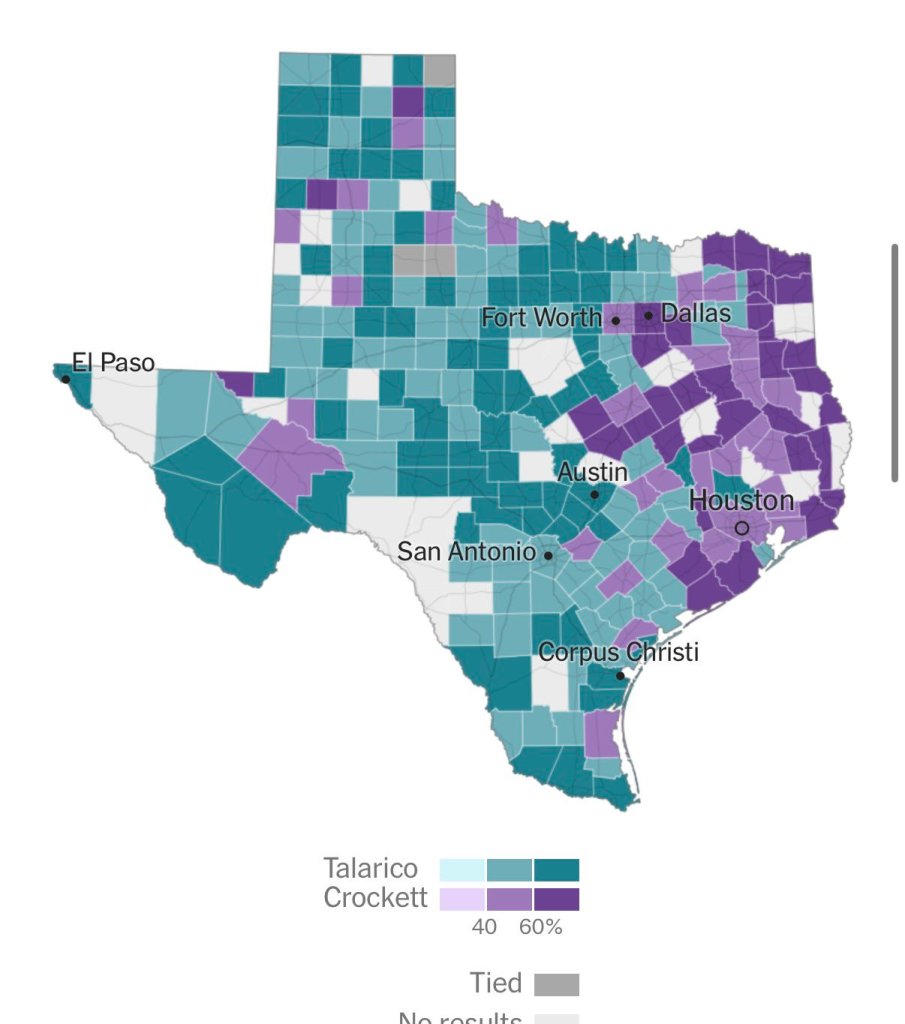
Before I go all in depth about a primary that I’ve been imploring people to ignore for months (I really can’t see a Democrat winning the Texas Senate race unless everything goes right), let’s take a look at the big picture on the night. For the most part, last night’s primaries were largely inconclusive as to whether or not we’re in an anti-establishment, insurgency election year. Talarico appears to have defeated Crockett in a race where both sides claimed to be something different and new. Christian Menefee, a brand new incumbent Congressman, leads long time incumbent Al Green in Texas 18, but who knows how much we should attribute this to any one specific thing (Green is a lightning rod in many ways). Julie Johnson trails in her Dallas area Texas 33 seat, but she trails former Congressman and Senate nominee Colin Allred, and like Texas 18, it’s most likely heading to a runoff. Embattled Texas 28 incumbent Henry Cuellar smacked his opposition by 15% and avoided a runoff. Over in North Carolina 4, Valerie Foushee leads by about a thousand votes as I write this, or just about 1% against Durham County Commissioner and leftist darling, Nida Allam. There was a ton of spending here, and the late money favored Allam. So yes, there were some very competitive primaries tonight, and some incumbents are going to lose, but not all of them, and some of them are essentially losing to other incumbents. Let’s call it basically what it is, an inconclusive round.
The Republicans had a much more insurgent election, which is remarkable after a decade of the most insurgent movement in modern political history. John Cornyn was very nearly the Senate Majority Leader like 15 months ago and today he’s heading towards a runoff against a guy who almost got impeached and sent to jail (Ken Paxton), and may not even ultimately hold much of a lead when the count is done. In Texas 23, Tony Gonzales “survived” the scandal for having an affair with a staffer who lit herself on fire then, but will go to a runoff. Dan Crenshaw got crushed in Texas 2. In North Carolina, the Senate President Phil Berger is apparently losing his primary by 2 votes. Despite the best efforts of nearly every significant Republican in America to bend over backwards for Donald Trump, the GOP’s cultural purge continues. I’m not even sure what the policy beef is at this point, nor do I think it matters. Republican voters don’t like the people doing Trump’s bidding, even as they like Trump and replace them with harder line candidates.
Now with all of that said, we can have dessert. Obviously the most important Senate nomination of the night was Roy Cooper in North Carolina, the best Democratic challenge candidate for Senate in the country this year. Texas had all the passion though. Now look, I don’t see either of them as winning, but it fired people up. There was a perception of Talarico as the progressive left’s candidate and Crockett as the “establishment” left’s candidate. This is kind of news to people actually important in both wings, but we digress. Crockett’s strategy was simply to double down on the last decade of Democratic strategy, leaning into the base vote hard and confronting Trump’s GOP on all fronts, especially culturally. Even so, many establishment folks privately didn’t see how it would work here. Talarico seems to want to be less culturally abrasive and try to persuade more moderate Republicans and Evangelicals with progressive Christianity style. I’ve said for a while I don’t think either will work, and this is a battle over whether it’s better to lose by 7% or 9%. While I generally do side with candidates like Crockett, I think that Talarico’s strategy has a slightly better (think 0% vs. 5%) chance of victory. I don’t think you can “turnout” your way through a rough electorate, in either a red area or bad year, and I definitely don’t think you can do that in Texas where you’re losing as many Latino votes as you’re winning. Talarico essentially won in any part of the state that doesn’t have a sizable Black population, and his campaign’s work on Latino voters clearly did pay off. Ultimately I don’t think the House Oversight Committee is a great place to launch any statewide campaign unless you’re in a very blue or red state, and Crockett was quite good at her job on that committee- which is probably the wrong skillset for a Democrat to win statewide in Texas. Again, I don’t think it will matter, so I stayed out of this fight largely. My guess is the somewhat bitter tone of this primary will make it hard for Talarico to turn out Black voters in November, but I also think he’ll lose for more reasons than that.
In the one set of bad news from the night, super douchebag and former Yankees First Baseman Mark Teixeira won the GOP nomination in Texas 21 and will probably win big now. I wasn’t a fan as a ballplayer and I’m not a fan now.
 Apocalypse Vibes